
Reviewed and updated: November 10, 2026
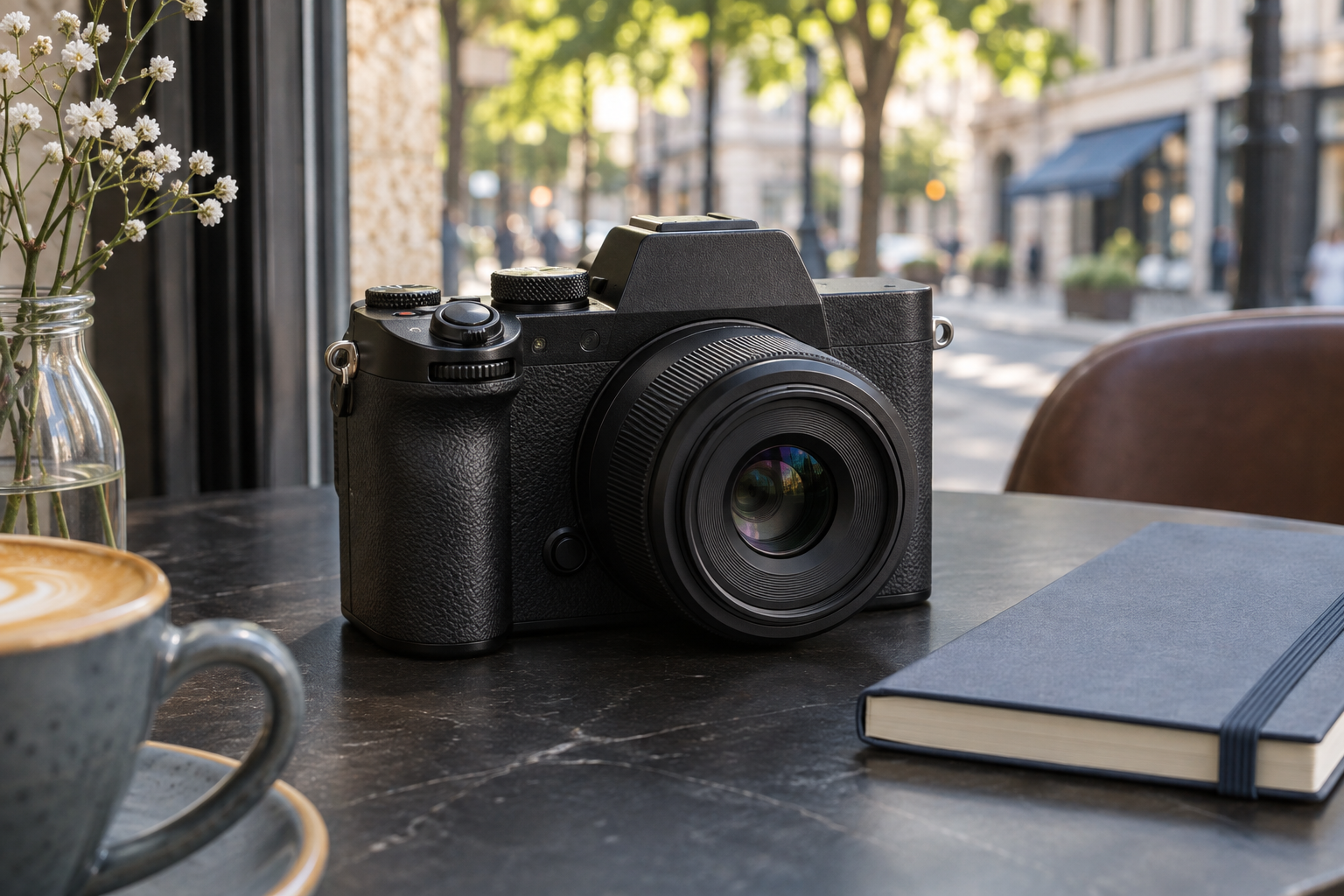
We recommend the Nikon NIKKOR Z 40mm f/2 if you want a small everyday lens for a full-frame Nikon Z camera, especially when your photographs move between people, street scenes and evenings indoors. It gives you a useful middle ground between a wider 35mm view and a tighter 50mm, with an f/2 aperture that adds flexibility as the light fades. The main compromise is its fixed focal length: in a small room, you may want more space around your subject than 40mm allows.
The NIKKOR Z 28mm f/2.8 is the alternative we would consider for that wider view. Both lenses keep your kit light, so this decision is less about saving a few grams than choosing the photographs you want to make. Your camera’s sensor size matters too: on a Nikon DX body, these become two quite different everyday options.
An everyday view that keeps attention on your subject
On full frame, 40mm lets you include some surroundings without making them the main event. Think of a friend at a café table, a person browsing a market or a detail in a shop window. You can show enough context to tell the story while keeping a clearer emphasis on the person or object than you would from the same position with 28mm.
That balance is the lens’s strongest reason to buy. If a wide zoom leaves you including too much pavement, ceiling or empty space, the 40mm can make your compositions more selective. It is still a normal-length lens rather than a telephoto portrait lens, so it will not bring a distant subject dramatically closer.
The limitation appears when you cannot step back. A small group across a dinner table may fit comfortably at 28mm but feel cramped at 40mm. Before replacing your zoom, spend an afternoon leaving it near 40mm on the body you intend to use. The useful question is whether that view feels natural in your regular spaces, rather than whether a prime is automatically an upgrade.
Nikon NIKKOR Z 40mm f/2
Our choice for a small full-frame everyday kit, with a selective normal view and a brighter maximum aperture. This button opens Amazon search results for the standard NIKKOR Z 40mm f/2.
View on Amazon (paid link)
Nikon NIKKOR Z 28mm f/2.8
The wider alternative for tight interiors and a more general everyday view on DX. This button opens Amazon search results for the standard NIKKOR Z 28mm f/2.8.
View on Amazon (paid link)
What the f/2 aperture adds
The 40mm opens one stop wider than the 28mm f/2.8. With the same scene brightness, that gives you room to use roughly twice the shutter speed at the same ISO, or a lower ISO while retaining the shutter speed. For an indoor portrait or a person moving through evening light, that flexibility can matter more than the small difference in lens size.
You do not need to photograph everything at f/2 to benefit. A wider aperture also gives you more control over how much background remains in focus, although subject distance and the distance behind your subject affect the result. A close portrait with a distant background is a different proposition from someone standing against a wall. The aperture number alone cannot promise a particular look.
There is also a reason to close the aperture: two people at different distances may need more depth of field than f/2 provides. If you mainly photograph groups in daylight, the brighter maximum aperture will play a smaller role. Our explanation of image stabilisation helps separate camera shake from subject movement when deciding what actually limits your indoor pictures.
A small lens, with useful everyday details
The standard 40mm weighs approximately 170 grams and measures 45.5mm from the mount flange. The 28mm is approximately 155 grams and 43mm long. Both make a compact companion for a Nikon Z body; the 15-gram difference is a weak reason to sacrifice the focal length you prefer. Consider the combined camera and lens rather than expecting a small lens to make every body pocketable.
Both have internal focusing, so focusing does not change their overall length. Each also has a control ring that can be assigned a supported function. That gives you an adjustment at the lens without adding a bank of dedicated controls. If you prefer physical switches and separate rings for different settings, this simple arrangement may feel limiting.
The shared 52mm filter thread is convenient if you eventually own both. A correctly sized screw-in filter can move between them without a step ring. Front and rear caps are supplied with the standard models; check the particular package before assuming that a hood or case is included. The ordinary 40mm and the retro-styled SE edition are distinct purchase options, so match the version you intend to order.
Close details are possible, but this is not a macro lens
The 40mm focuses down to 0.29 metres from the camera’s focal plane and reaches 0.17x maximum reproduction. That is useful for a plate of food, a larger flower or an object on a table, while leaving room to return to ordinary scenes without changing lenses. It is not designed to fill the frame with very tiny subjects.
The 28mm reaches 0.2x and focuses down to 0.19 metres, but that shorter distance is measured from the sensor plane, not the front of the lens. You will be working close to your subject, where the camera can block light. For detailed jewellery or small insects, a dedicated macro lens offers a more appropriate starting point. Our product photography advice can help you judge whether framing and lighting, rather than another lens, are your immediate constraint.
On a DX camera, give the 28mm a closer look
Both lenses cover full-frame FX and smaller DX Nikon Z sensors. On DX, the 40mm gives the angle of view of a 60mm lens on full frame, while the 28mm gives a 42mm-equivalent view. The focal lengths themselves do not change; your camera records a smaller portion of the image.
That shifts our recommendation. For a single everyday prime on DX, the 28mm is easier to accommodate indoors and for photographs that include your surroundings. The 40mm becomes a more selective option for individual people and details. Neither fits a Nikon F-mount DSLR directly: the Z in the name identifies the mirrorless mount, not simply a newer version of an F lens.
Our verdict
The NIKKOR Z 40mm f/2 is a compelling everyday prime when you want a compact full-frame kit with a little extra aperture flexibility and a clear emphasis on your subject. We would buy it for people, everyday details and evenings out, provided you are comfortable with the framing. For cramped interiors, wider scenes or a first everyday prime on DX, we would favour the 28mm f/2.8. The cards above open Amazon searches for the standard versions, so you can check the exact lens and package before ordering.