
Reviewed and updated: November 9, 2026
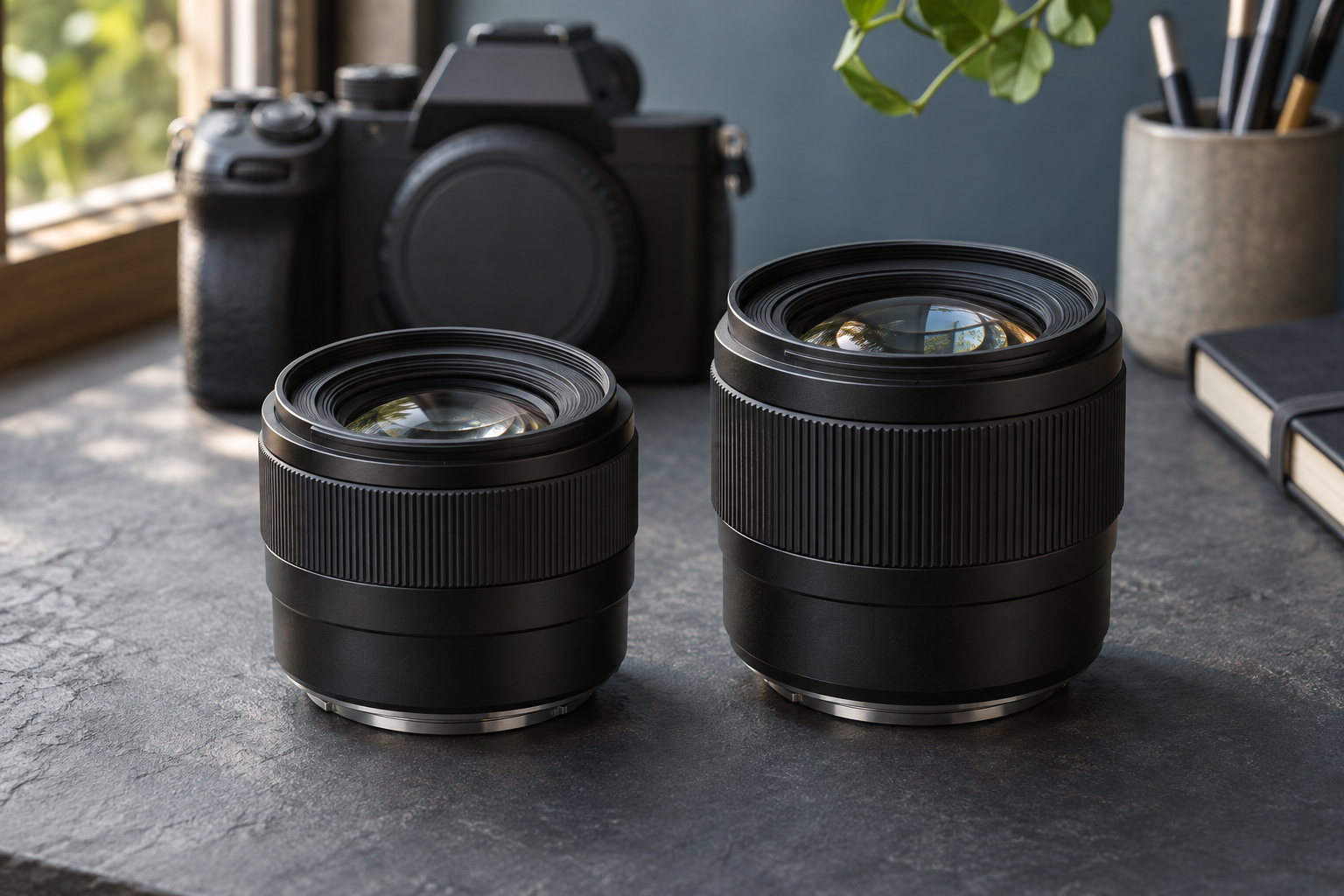
The Canon RF35mm F1.8 Macro IS STM is our stronger all-round choice for an EOS R camera. Its wider view is easier to use indoors, its close focusing gives you more scope for small details, and optical stabilisation adds help with handheld photographs of still subjects. The RF50mm F1.8 STM answers a different priority: a tighter view in a noticeably smaller, lighter lens.
Both open to f/1.8, so that headline specification does little to settle the comparison. The real choice is between versatility and a compact, more selective view. For family photographs around the house, food and everyday details, the 35mm earns its extra size. For portraits with room to step back, the 50mm is an appealing way to keep your camera easy to carry.
Two different ways to frame everyday photographs
On the same camera from the same position, the 35mm includes more of the scene. That gives you room for the setting around a person: the table at dinner, a room during a family gathering or the surroundings that explain where a photograph was taken. It is a useful advantage when the wall behind you prevents another step back.
The 50mm narrows that view. You can concentrate on one person and leave more of a busy room outside the frame, which makes it attractive for portraits and details that do not need much context. The tradeoff appears when you want a full-length portrait or a small group indoors. A view that feels pleasantly selective outside can become restrictive in a hallway.
That does not make one focal length universally better. It means the rooms and subjects you photograph should carry more weight than a lens’s reputation as an everyday favourite. For a first prime, we would lean toward the 35mm’s flexibility unless you already know that the tighter framing is what you want.
Canon RF35mm F1.8 Macro IS STM
Our everyday choice for a wider indoor view, closer details and lens-based stabilisation. This button opens Amazon search results for the RF35mm F1.8 Macro IS STM.
View on Amazon (paid link)
Canon RF50mm F1.8 STM
A lighter, smaller prime for tighter portraits and selective framing, without an optical stabiliser. This button opens Amazon search results for the RF50mm F1.8 STM.
View on Amazon (paid link)
The 35mm’s close focusing is a useful second role
The RF35mm focuses down to 0.17 metres and reaches 0.5x maximum magnification, against 0.30 metres and 0.25x for the RF50mm. Those figures translate into a meaningful difference when you move from a whole plate of food to a texture on it, or from a flower arrangement to a smaller detail. You have more close-up scope without changing lenses.
At 0.5x, a subject can be reproduced at half its actual size on the sensor. That is useful close-up capability, though it is not life-size 1:1 macro. For very small subjects, a dedicated macro lens may still be the more suitable purchase. The 35mm’s appeal here is combining ordinary photographs and closer details in one lens.
Close focusing also changes the working space. As you move in, your camera and lens can obstruct the light or cast a shadow over the subject. The extra magnification is more useful when the lighting and background still work at that distance. Our product photography guide develops those considerations without requiring another lens purchase.
Stabilisation matters when your subject stays still
The RF35mm includes optical image stabilisation, with Canon’s five-stop rating based on a CIPA test using the EOS R. Treat that as a specified test result rather than a promise for every body, shutter speed or photograph. Its practical attraction is help with camera shake when you photograph a still subject handheld.
The RF50mm has no optical stabiliser. Any in-body stabilisation therefore depends on the camera you pair it with and that body’s capabilities. If your camera lacks such a system, this is a more significant difference than it might appear from looking only at the shared f/1.8 aperture.
Neither system can hold a moving child, pet or person still. A sharp photograph of movement still depends on a suitable shutter speed. This distinction matters when deciding whether stabilisation solves your particular low-light problem: camera shake and subject movement are separate causes of softness. Our explanation of image stabilisation helps you tell them apart.
The 50mm makes the smaller kit
At approximately 160 grams and 40.5mm long, the RF50mm saves 145 grams against the 305-gram, 62.8mm RF35mm. That is a clear advantage if you want a light camera to carry throughout an afternoon. A lens that stays on the camera is often a more useful purchase than a more versatile one you regularly leave behind.
The smaller package comes with specific compromises: less room in the frame, less close-up magnification and no lens-based stabilisation. If your photographs rarely call for those features, carrying the extra size of the 35mm may bring little benefit. For a compact portrait setup, the 50mm has a coherent purpose rather than merely being the lens with fewer features.
Accessories differ as well. The RF50mm takes 43mm screw-in filters and the RF35mm takes 52mm filters. They will not transfer directly between the two sizes. Check the contents of the particular offer before adding a hood, case or filter, so your order contains the accessories you intend to use rather than duplicates of something already included.
A quick way to settle the focal-length question
If your current zoom covers both 35mm and 50mm, try those settings on the camera you intend to use. Frame a person, a tabletop subject and a scene in your smallest room. You are looking for the view that lets you compose comfortably, rather than trying to reproduce a laboratory comparison of the lenses.
Sensor size affects how much of the scene your camera records, so make that comparison on your own body. A focal length recommended by someone using a different sensor may feel tighter than you expect. This is especially relevant for indoor groups and arm’s-length video, where you cannot always create more distance.
Both lenses belong to Canon’s RF-mount EOS R system. Match that mount when ordering: an EF 50mm with a familiar aperture is a different lens, not another name for the RF model. The complete product names in the cards identify the versions compared here, and their buttons open Amazon searches for those lenses.
Our verdict
We recommend the RF35mm for the more flexible everyday kit. Its wider framing, closer focusing and optical stabilisation complement one another, particularly for indoor scenes and still details. The RF50mm is the better fit when you already enjoy its tighter view and want to minimise what you carry. Let the photographs you regularly make settle the choice: the 35mm covers more situations, while the 50mm keeps a focused portrait kit smaller.