
Reviewed and updated: November 11, 2026
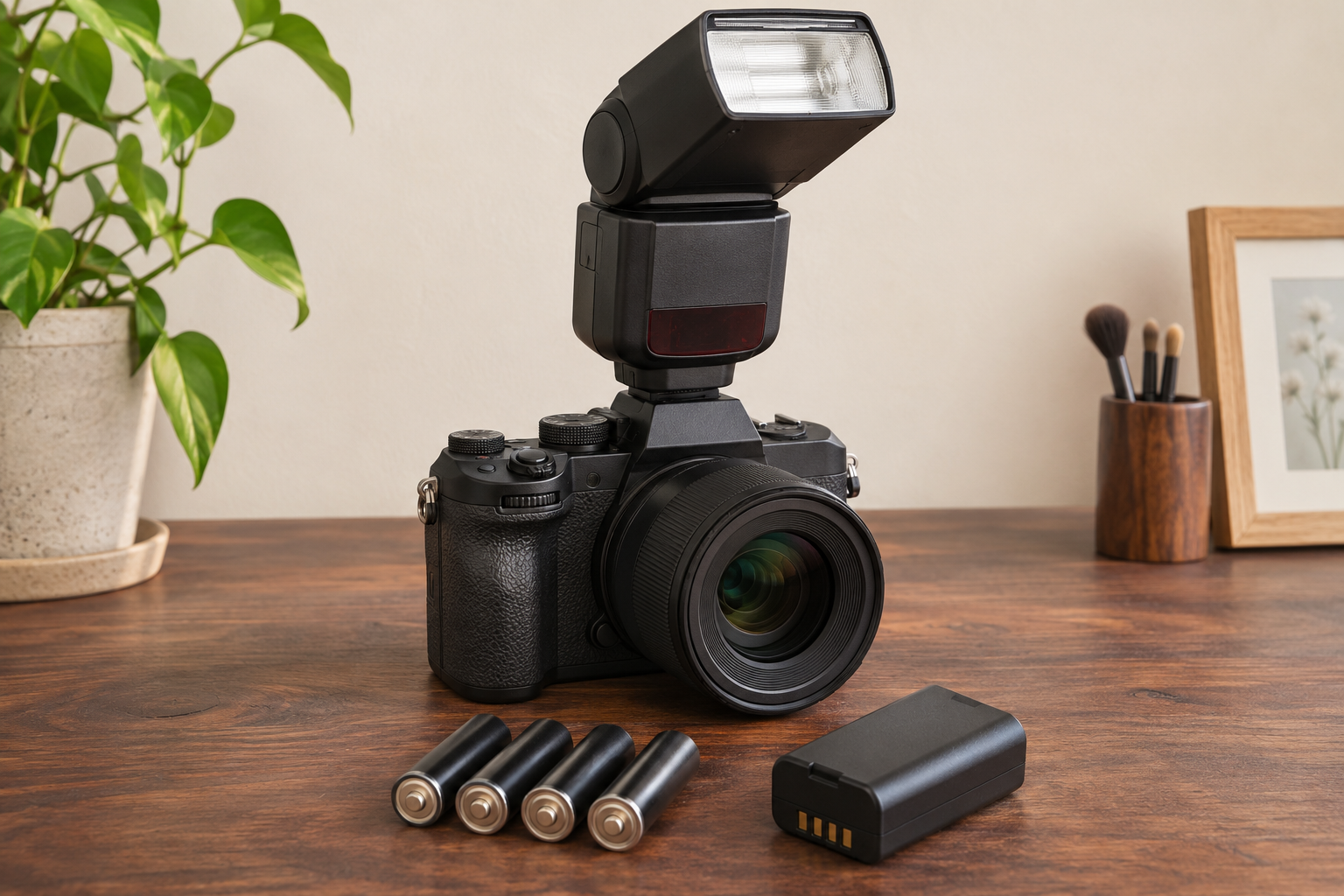
We would choose the Godox V860III for Nikon if flash is becoming a regular part of your photography and you want the convenience of a dedicated rechargeable battery. The TT685II is the more natural fit when you prefer replaceable AA cells, already own a suitable charger, or want a flash for occasional portraits and family gatherings. Both give you a head you can tilt and turn for bounce lighting, Nikon i-TTL automation and room to explore off-camera flash.
The V860III adds a useful LED modelling lamp and a dedicated TTL/manual shortcut, but those extras do not make the TT685II a basic manual-only flash. The main decision is how you want to power and handle your light, rather than whether you need to buy the V860III before you can learn to make better-lit photographs.
Choose the battery system you will enjoy using
The TT685II takes four AA batteries, with rechargeable NiMH cells recommended and LR6 alkaline cells also supported. That is appealing if your camera bag already contains AA-powered equipment. You can keep matched charged sets together, move to a fresh set when needed and avoid committing another accessory to a dedicated battery format.
The tradeoff is managing four individual cells each time. A mixed collection of partly charged batteries is less convenient than a clearly organised set, and a rechargeable AA setup still needs a suitable charger. Think about the complete purchase rather than treating the flash body as everything you need. If you already have a reliable AA arrangement, the TT685II fits it neatly.
The V860III uses a removable lithium-ion pack instead. For a portrait session or an evening when you expect to use flash repeatedly, one pack is straightforward to charge, insert and swap. Its appeal is simplifying the equipment you prepare before leaving home. You will need the correct compatible pack and charging accessories, though; a spare set of AAs cannot stand in for a flat pack.
Godox TT685II for Nikon
The AA-powered option for occasional bounce flash or an existing rechargeable-AA setup. This button opens Amazon search results for the Nikon TT685IIN.
View on Amazon (paid link)
Godox V860III for Nikon
Our choice for frequent flash sessions when a dedicated rechargeable pack and LED modelling lamp are useful. This button opens Amazon search results for the Nikon V860IIIN.
View on Amazon (paid link)
Both give you the important flash controls
With a compatible Nikon camera, both versions support i-TTL automatic flash and manual power control. TTL lets the camera and flash work together to calculate flash output, which is useful when the distance to your subject keeps changing. Manual power is attractive when your subject and light stay in place and you want the next photograph to match the last.
That shared foundation matters more than an intimidating list of modes. You can start by photographing someone with bounced TTL flash, then move into a more controlled portrait setup without replacing either unit. The V860III’s dedicated TTL/manual shortcut makes changing between those approaches more convenient; the TT685II still provides both modes through its controls.
Both also support high-speed sync with a suitable camera, but compatibility and camera settings remain part of the purchase. It is useful when you want flash alongside a faster shutter speed, rather than a promise of unlimited outdoor reach. For a first indoor flash, head movement and a power system you like will usually shape your experience more often than the fastest advertised sync setting.
The bounce head opens up the same creative possibilities
Each flash can swivel through 330 degrees and tilt from slightly downward to 120 degrees upward. You can direct light toward an appropriate wall or ceiling instead of pointing it straight at your subject. For a family photograph in a modest room, that flexibility is a compelling reason to buy either one rather than a tiny flash with a fixed head.
The room still matters. A nearby neutral ceiling gives you a different starting point from a dark, high ceiling or a strongly coloured wall. Buying the V860III will not make an unsuitable bounce surface disappear. If most of your photographs happen outside or in large rooms, consider how you will position or modify the light as part of your purchase.
Both offer a 20–200mm zoom range for adjusting flash coverage. That setting controls the spread of the beam; it does not turn the flash into a larger, softer light source. If a small portrait setup is your goal, our speedlight softbox guide can help you consider the modifier and mounting arrangement alongside the flash itself.
The V860III adds a light you can see before the photograph
The V860III’s LED modelling lamp has ten brightness levels. Its continuous light can help you see a nearby subject while composing or adjusting a small still-life setup. That can be a useful convenience alongside the main flash, although it has a different role from the brief burst that lights the photograph.
The LED does not reproduce the illumination of a tilted or remotely positioned flash, so judge the actual flash photograph when adjusting the lighting. If you mainly want a flash that lives on the camera for occasional bounced portraits, the modelling lamp may add little to your buying decision. For repeated tabletop work, it is a stronger reason to favour the V860III.
Either can grow into an off-camera setup
Both flashes have Godox’s built-in 2.4GHz wireless system, with transmitting and receiving functions. You can therefore plan a setup that places the flash away from the camera. A compatible camera-mounted Godox X trigger is a separate purchase when you want to control a remote flash without keeping another flash on the camera.
That creates room to grow, but the accessories need to fit your plan. A stand, an appropriate flash holder and a modifier may change what you need to order more than the difference between these two bodies. For a stationary subject, our product photography advice helps you think through light direction and reflections before filling a bag with extra equipment.
Order the Nikon version and the right package
The recommendations here are the Nikon-specific TT685IIN and V860IIIN. Versions for other camera systems share familiar names but are not interchangeable purchases for on-camera TTL operation. Confirm your exact camera against the current compatibility information, including any required firmware or shoe adapter, rather than relying on the word Nikon in a broad seller title.
Check what comes with the particular offer, especially the V860III battery and charging accessories or the TT685II’s AA requirements. Neither flash is waterproof. Keep it dry, avoid firing directly into someone’s eyes and follow the cooling instructions during repeated use. Those are ownership considerations for either choice, rather than reasons to expect a different result from the same lighting arrangement.
Our verdict
The V860III is our pick for frequent flash photography when a dedicated battery, modelling lamp and quick mode change make your sessions easier. The TT685II makes more sense when AAs already suit your kit and you want the same core bounce, TTL and wireless possibilities. Choose the power system you are happy to maintain; the cards above open Amazon searches for the Nikon versions so you can check the exact model and package.