
Reviewed and updated: November 13, 2026
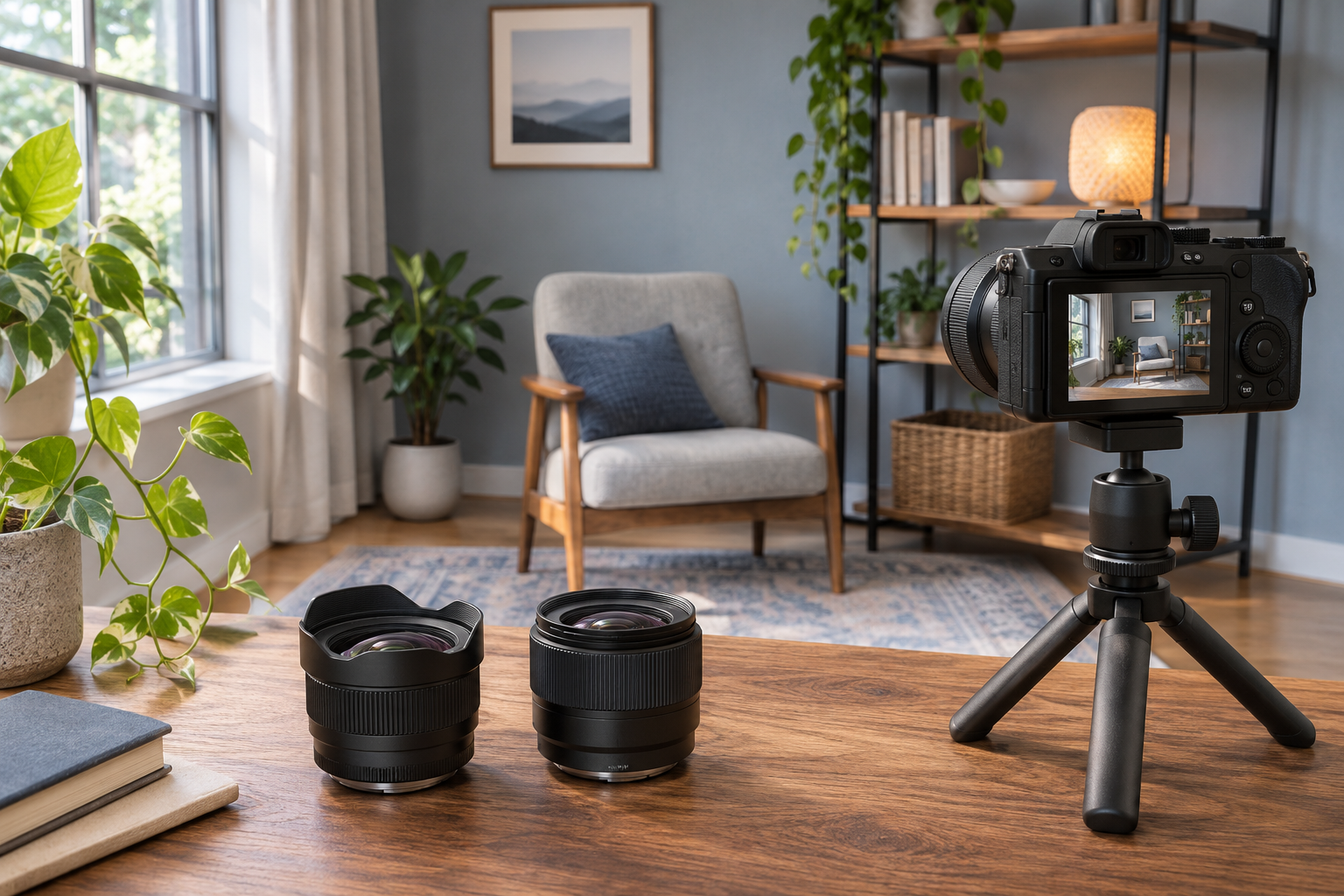
More room in the frame is the best reason to buy Sony’s E 11mm F1.8. We recommend it for an APS-C E-mount camera when you film at arm’s length, work in a small room or want your surroundings to be part of the picture. The E 15mm F1.4 G is our preference for a more deliberate setup with space behind the camera: its brighter aperture and dedicated aperture ring make it an appealing choice for seated videos, environmental portraits and evening photography.
These are two small lenses with noticeably different personalities. The 11mm gives you a generous view without needing to back into the wall. The 15mm helps you frame more selectively, but it cannot give you that lost space back. Start with where the camera will sit, then decide how much the extra aperture and controls matter.
The room usually decides before the aperture does
On Sony APS-C, the 11mm gives a field of view equivalent to 16.5mm on full frame; the 15mm corresponds to 22.5mm. Both are wide, yet the difference is meaningful at a desk. The 11mm can include your hands, the tabletop and more background while the camera stays nearby. That is useful for a craft demonstration, a room tour or talking to the camera without an unusually long grip.
The wider view also includes more things you may not want: an untidy corner, a bright window or objects near the frame edges. The 15mm can make a small filming area feel more intentional when you have enough distance. Neither is a zoom, so changing between a roomy view and a tighter composition means moving the camera or changing lenses.
Sony E 11mm F1.8
Our pick for arm’s-length recording and small rooms where a generous view matters most.
Find in Amazon (paid link)
Sony E 15mm F1.4 G
Our choice for a more selective wide view, a brighter aperture and direct aperture-ring control.
Find in Amazon (paid link)
Keep faces comfortable in a very wide picture
With the 11mm, give your face some breathing space and keep it near the centre. Moving extremely close exaggerates the difference between nearer and farther features; placing a face near the edge can also look unflattering in a wide image. Those are composition considerations rather than a reason to avoid the lens. A little extra distance can keep the sense of place without making your nose the main subject.
The 15mm is easier to favour for a seated introduction when the tripod can move farther back. It still includes context, but you do not need to fill every corner with your room. For a small group around a table, the 11mm’s extra coverage may be more useful than the 15mm’s brighter aperture. Think about everyone in the frame, not just the person nearest the camera.
What the brighter 15mm gives you
The 15mm opens to f/1.4, compared with f/1.8 on the 11mm. That gives you more exposure flexibility in a dim room and more scope for a softly rendered background. It is a useful benefit for evening photographs or a fixed-camera video setup, especially when you can separate yourself from the background. It is less persuasive when your main problem is fitting yourself into the picture.
A bright aperture does not automatically make an attractive video. Wide open, the area that looks sharply focused is shallower, so a moving subject can make focus accuracy more important. For showing an object and your face together, stopping down may be the better creative choice. Buy the f/1.4 option for flexibility, rather than assuming every recording should use its widest setting.
The controls are a real reason to choose the G lens
The 15mm has an aperture ring with a click on/off switch. Leave the clicks on for distinct adjustments in still photography, or turn them off for smooth ring movement during video work. Having aperture control on the lens can feel more direct than reaching for a camera dial, particularly when the camera is mounted and you are working from its side.
The 11mm keeps aperture adjustment on the camera. Both lenses provide an AF/MF switch and a focus-hold button, so the smaller option still gives you useful controls. Both also use two linear autofocus motors and offer Linear Response manual focusing. Your camera’s focus settings and subject recognition remain part of the result; the lens does not independently guarantee that every moving face stays sharp.
Allow room for your camera’s video settings
Neither lens includes optical SteadyShot stabilisation. Handheld steadiness therefore depends on your camera’s available stabilisation, your support and the way you hold the setup. Some electronic stabilisation and recording modes narrow the captured view. The amount depends on the camera and mode, so the lens’s basic equivalent focal length does not describe every video configuration.
This strengthens the case for 11mm when arm’s-length framing is the priority. For recordings from a desk, a stable support may matter more than buying the widest possible lens. Our PIXI and PIXI EVO comparison helps you consider a compact tabletop setup. Include the camera and lens together when judging support capacity and balance.
Small enough to bring beyond the filming desk
At about 181g and 57.5mm long, the 11mm is the smaller option; the 15mm weighs about 219g and is 69.5mm long. Both make sense on a compact APS-C body, rather than turning it into a large rig. The lighter 11mm is particularly appealing on a handheld grip, while the 15mm remains easy to consider for a bag that serves both photography and video.
A shared 55mm front-filter size is convenient if you already own suitable filters. A neutral-density filter can be useful for bright outdoor video when you want to keep a wide aperture. Both lenses have dust- and moisture-resistant designs, but that does not make either waterproof or remove the need to protect your camera in rain.
Close details and the right camera system
The 11mm focuses down to 0.15m in autofocus and 0.12m manually; the 15mm reaches 0.20m and 0.17m respectively. These distances are measured from the image plane, not the front of the lens. They allow creative close details with plenty of surroundings, though neither is a life-size macro lens. Very close placement can also bring the camera’s shadow into your scene.
Both are Sony E-mount APS-C lenses. They are a natural match for that format, rather than full-frame FE lenses for using an entire full-frame sensor. A future move to full frame is a reason to think about your lens plan, not a reason to buy a view that is awkward for your current camera.
Our recommendation
The E 11mm F1.8 is the stronger buy for a tight room, handheld self-recording and a generous sense of place. The E 15mm F1.4 G suits you better when your framing already works and you want a brighter aperture with direct aperture control. Choose the view that makes your actual filming space enjoyable to use; a more impressive specification is not a substitute for fitting the picture.