
Reviewed and updated: October 18, 2026
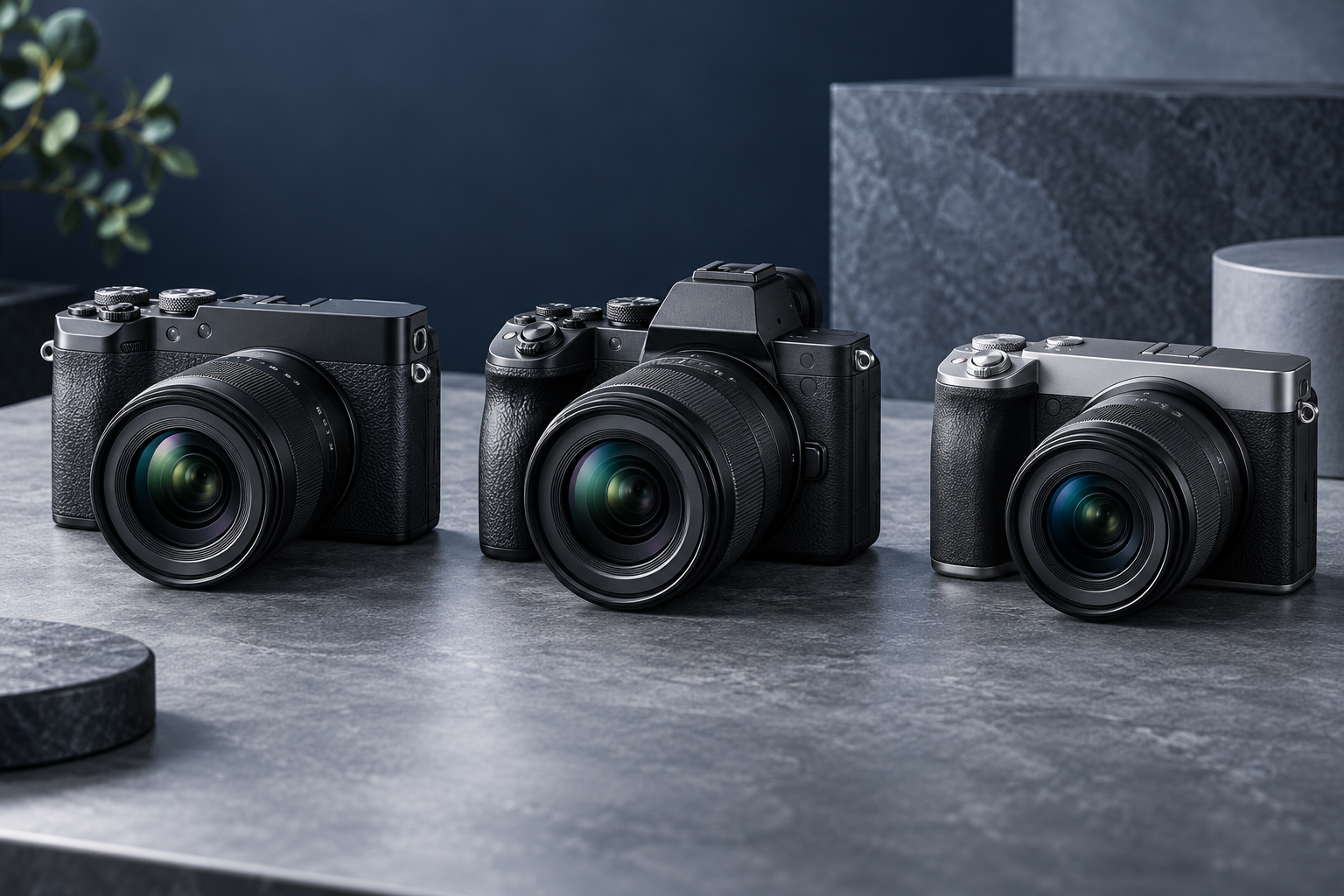
A beginner camera should make focus, exposure, lenses, files, and sharing easier to learn. Compare the exact kit, viewfinder, screen, autofocus, stabilization strategy, and system cost.
This guide was reviewed against current official product information where a model is discussed. Specifications and packages can change, so verify the exact label or manufacturer page before acting.
Define beginner by the pictures you want
A beginner photographing family, travel, school sports, products, or video needs different features. Write down the most common subject, expected light, desired video use, and whether you will carry extra lenses. The best first camera is the one you will bring and practice with, not the model with the longest specification list. Budget for a memory card, spare battery, simple bag, and the lens that fits the subject. The kit lens is a starting point, not a lifetime commitment.
Canon EOS R50 as the compact starting point
Canon describes the EOS R50 as a compact 24.2-megapixel APS-C RF-mount camera with Dual Pixel CMOS AF II and uncropped 4K up to 30p derived from 6K data. Its vari-angle screen and close-up demonstration mode suit family video and simple product work. The small body is approachable, but the control layout and lack of in-body stabilization should be considered. Confirm the exact RF-S 18-45mm kit, charger, battery, regional warranty, and whether a memory card is included.
Nikon Z50II for newer processing and controls
Nikon's Z50II uses a 20.9-megapixel DX sensor and EXPEED 7 processor with subject detection, a vari-angle touchscreen, electronic viewfinder, built-in flash, and 4K options. Nikon lists support for Z-mount lenses and F-mount lenses through an adapter with restrictions. It is larger and newer than the original Z50, so do not confuse listings. The exact model name includes II. Compare the 16-50mm kit, body controls, lens roadmap, and the EN-EL25a battery system.
Sony a6400 for a mature E-mount system
Sony's a6400 remains in the current support and product ecosystem with a 24.2-megapixel APS-C sensor, E mount, electronic viewfinder, tilting screen, and well-known subject autofocus features. Its older menu and screen articulation differ from the fully vari-angle designs in the other two. It also lacks in-body stabilization. The mature E-mount lens selection is a major strength. Verify that an Amazon result is the a6400, not an a6100, a6500, or body-only bundle with third-party accessories.
Compare autofocus by subject and interface
All three can focus far better than older entry cameras, but button access, touch behavior, subject detection, and lens performance shape the experience. Try to handle the cameras or study the manuals. Confirm how to move the focus point, switch subject types, and override automatic selection. Product-review autofocus is useful for objects held toward the camera; sports needs tracking and a suitable lens. No body can compensate for a slow aperture, poor technique, or a subject too small in the frame.
Treat stabilization as a system question
These bodies rely largely on lens-based optical stabilization and electronic video methods rather than in-body sensor stabilization. Check the exact lens for Canon IS, Nikon VR, or Sony OSS rather than assuming the kit provides it. Stabilization helps camera movement, not subject motion. A faster shutter, wider aperture, higher ISO, support, or better timing may still be required. For handheld video, compare crop, rolling shutter, lens stabilization, and microphone needs instead of reading one stabilization label.
Look beyond the body price
A camera system includes lenses, batteries, cards, flashes, microphones, remotes, software, and replacement availability. Price a useful second lens before committing. Canon RF-S, Nikon Z DX, and Sony E have different native options and third-party support. Adapters add cost and may change balance or autofocus behavior. Avoid bundles padded with low-quality filters and tripods. Buy the exact body and lens combination from a seller with a clear return policy and manufacturer warranty coverage.
Make a choice that supports learning
Choose the EOS R50 when compact size, Canon's interface, and straightforward family or creator features lead. Choose the Z50II when its newer processor, viewfinder, controls, subject detection, and Nikon Z path fit. Choose the a6400 when E-mount lens depth and a proven compact body matter more than a fully articulating screen or newer menus. Verify official details, then use the paid Amazon searches to compare exact kits. Spend the first week learning exposure compensation, focus selection, and file backup.
Quick checklist
- Name the main photo and video subjects.
- Verify the exact body and kit lens.
- Compare screen, viewfinder, and controls.
- Check lens-based stabilization explicitly.
- Price batteries, cards, and a future lens.
- Reject unclear bundles and model substitutions.
Why these checkpoints matter
- Name the main photo and video subjects. This defines the starting condition and prevents the rest of the process from resting on an assumption.
- Verify the exact body and kit lens. This narrows the choice to evidence you can verify on the exact label, model, or scene.
- Compare screen, viewfinder, and controls. This checkpoint reduces avoidable risk before another variable is introduced.
- Check lens-based stabilization explicitly. This keeps the routine compatible with the person, product, material, or equipment involved.
- Price batteries, cards, and a future lens. This creates a repeatable step instead of relying on memory or marketing language.
- Reject unclear bundles and model substitutions. This final review catches changes in condition, availability, or instructions before the next use.
Common questions
Which has the highest resolution?
The EOS R50 and a6400 are about 24.2 megapixels; the Z50II is 20.9 megapixels. Resolution alone should not decide the purchase.
Do these cameras have in-body stabilization?
These models generally rely on stabilized lenses and electronic video options. Verify the exact lens and mode.
Is the Sony a6400 too old?
It is older, but still supported and connected to a broad E-mount lens system. Compare current needs, warranty, and interface rather than age alone.
Official product references
Compare current Amazon listings
Canon EOS R50 with RF-S 18-45mm kit
Confirm the exact product, model or size, package contents, seller, current price, and availability.
Check current Amazon listings (paid link)(paid link)
Nikon Z50II with 16-50mm kit
Confirm the exact product, model or size, package contents, seller, current price, and availability.
Check current Amazon listings (paid link)(paid link)
Sony a6400 with 16-50mm kit
Confirm the exact product, model or size, package contents, seller, current price, and availability.
Check current Amazon listings (paid link)(paid link)