
Reviewed and updated: November 16, 2026
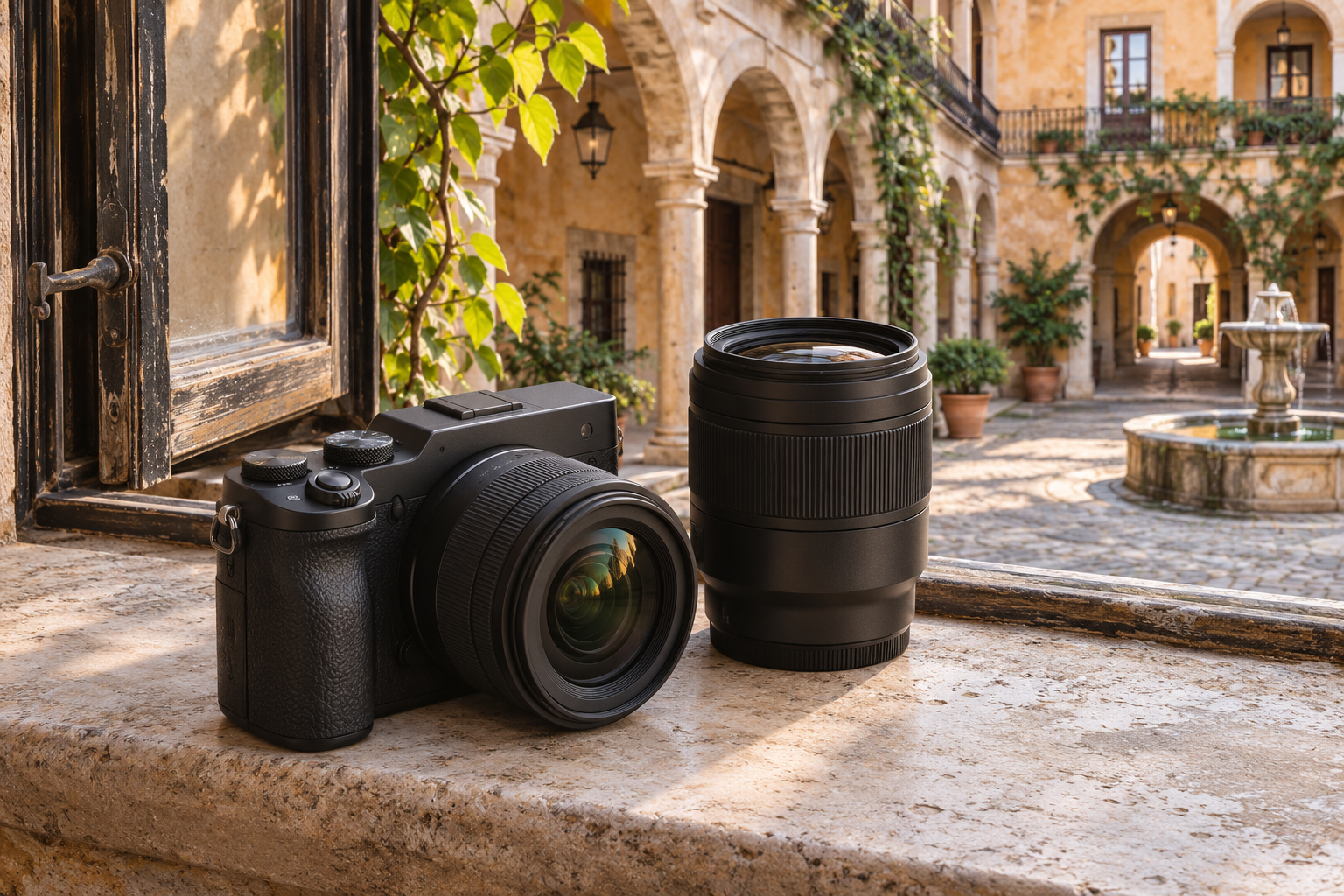
Canon’s RF-S 10-18mm makes an inviting addition to a small travel kit: it gives you a much wider view without asking you to carry a substantial lens. We’d recommend it for daylight exploring, architecture and handheld photographs of places. The Sigma 10-18mm F2.8 DC DN Contemporary is the more appealing choice when your photography regularly continues indoors or into the evening. Its brighter aperture gives you more freedom with shutter speed, while the Canon wins on lightness and adds optical stabilisation.
Both bring an ultra-wide zoom range to a Canon APS-C EOS R camera. The decision is less about fitting more into the frame than about the photographs you want to make once you’re there. A quiet church interior, a family gathering after sunset and a long afternoon wandering a city place different demands on a lens.
The Canon is easy to take along
At approximately 150g, the Canon feels like a sensible extension of a deliberately small camera kit. It retracts for storage by turning the zoom ring, so it doesn’t need to occupy its working length in your bag. That’s an attractive combination for a lens you might bring as a second option alongside your everyday zoom, rather than leave on the camera all day.
The 10mm end gives you the broad view that a typical standard zoom can’t provide. A courtyard can become a picture about the surrounding buildings; a small room can include the window light and furniture that give it character. Zoom towards 18mm and you can make a tighter composition without immediately changing lenses. Both lenses cover this same range, so neither offers a fundamentally wider category of picture.
Canon’s built-in optical stabilisation is particularly useful for that kind of handheld sightseeing. It helps counter camera movement while you photograph a stationary subject, letting you work more comfortably as the light drops. The benefit is strongest when the scene itself stays still: a decorated ceiling or an evening street without moving subjects is a better match than people walking through it.
The variable f/4.5-6.3 maximum aperture is the main compromise. You have less light available at the longest setting, so the lens is happiest outdoors or where you can accept a slower shutter speed. For landscapes photographed at a smaller aperture, the Sigma’s f/2.8 may add little to the picture you intended to take. That makes the Canon’s lighter carry and stabilisation a persuasive combination.
The Sigma earns its place as the light changes
Sigma’s constant f/2.8 aperture changes what you can do with the same wide view. In a softly lit room, you can use a faster shutter speed or lower sensitivity than the Canon permits at its widest aperture, with the other settings held equal. That’s valuable when your subject includes people: a brighter lens helps you keep their movement from becoming a blur.
A meal with friends is a good example. You may want the table, the room and the people together, rather than a tightly cropped portrait. The Sigma gives you the wide framing and more light to work with, making it our preference for this sort of evening photography. Stabilisation can steady your hands, but it can’t keep a person still during an exposure.
The aperture also stays available as you move from 10mm to 18mm. For video, that means zooming doesn’t force a smaller maximum aperture halfway through a composition. You can establish an exposure at f/2.8 and retain that setting across the range. It’s useful flexibility for filming indoors, especially when you can’t simply add more light to the room.
You do carry more lens. The Sigma in Canon RF mount weighs 270g, which is still compact for an f/2.8 ultra-wide zoom but noticeably more than the Canon’s 150g. We’d accept that difference for regular indoor work. For a second lens brought mainly for occasional sunny landscapes, it’s harder to justify carrying the extra capability when you seldom use it.
Canon RF-S 10-18mm F4.5-6.3 IS STM
A light companion for daylight exploring and handheld photographs of places, with optical stabilisation to steady your view.
Find in Amazon (paid link)
Sigma 10-18mm F2.8 DC DN Contemporary — Canon RF
Our pick for indoor and evening photography when a bright aperture matters more to you than the lightest carry.
Find in Amazon (paid link)
Wide views with a personal point of view
These lenses are at their most enjoyable when the surroundings contribute to the photograph. A person beside a sweeping staircase or a bicycle against an interesting doorway can give a wide scene a clear centre of attention. The 10mm setting invites you to include that context; the longer end lets you simplify the picture when the edges become distracting.
Neither replaces a longer portrait lens for close, flattering headshots. Move very close with an ultra-wide lens and nearby features become prominent relative to the background. That can be playful for an expressive travel picture, but it’s a different look from a conventional portrait. The Sigma’s f/2.8 offers some separation at closer distances, rather than turning every wide composition into a blurred-background photograph.
Close focusing adds another creative possibility. The Sigma focuses down to 11.6cm at 10mm, measured from the camera’s sensor plane, so a foreground detail can become a strong part of the scene. Canon offers up to 0.5x magnification in manual focus at 10mm; its autofocus maximum is 0.23x at 18mm. The manual-focus distinction matters: the closer Canon view takes more deliberate positioning than an ordinary autofocus snapshot.
Which one belongs in your Canon kit?
For handheld video, decide how you intend to support the camera as well as how much light you need. The Canon includes lens-based stabilisation; the Sigma relies on the camera or your support setup for stabilisation. Available in-body and digital options vary by camera, and digital stabilisation can crop the view. A brighter aperture and steadier footage solve different problems, so neither specification alone settles that decision.
Both are native RF-mount options designed around APS-C coverage. For the Sigma, the Canon RF version is the one that fits this comparison; its Sony, Fujifilm and L-mount versions are different fittings. These aren’t the lenses to buy for full-frame coverage on a larger-sensor EOS R body. Nor are they direct replacements for a DSLR lens: the older Canon EF-S 10-18mm belongs to a different mount system.
A few small practical differences can matter in an existing bag. Canon uses 49mm filters, while Sigma uses 67mm filters and includes a push-on petal hood. Canon’s matching hood is sold separately. Sigma also has a rubber seal at the mount, whereas Canon lists no weather-resistant construction. Treat that mount seal as added protection at the connection, rather than permission to expose the whole kit to heavy rain.
Our recommendation
We’d add the Canon to a light travel kit for its easy carry, useful wide range and optical stabilisation. It makes particular sense when most of your pictures are places photographed in daylight. The Sigma is our choice when the wide zoom will be a regular part of your indoor, evening or video work. Its f/2.8 aperture gives you room to keep photographing as the light changes, and that is the strongest reason to carry the larger lens.