
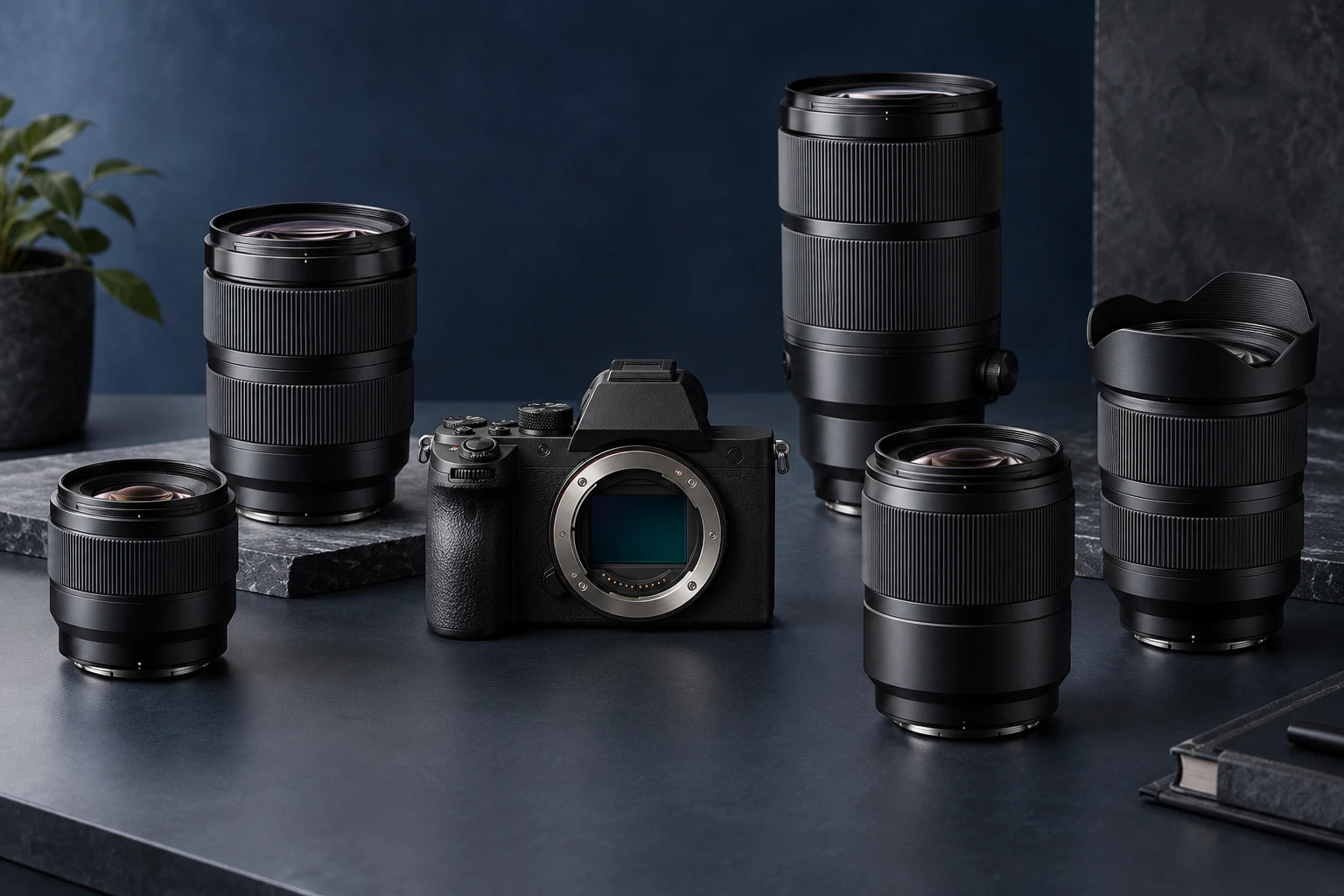
Best Sony Full-Frame Lenses in 2026: Five Useful Choices
Sony’s full-frame E-mount lens catalog ranges from tiny primes to professional zooms and long wildlife lenses. “Best” depends on subject, focal length, aperture, focusing distance, weight, and budget. These five choices cover common needs. Confirm that a lens carries full-frame FE coverage; APS-C E lenses mount physically but crop a full-frame camera or leave the frame uncovered.
Our recommended shortlist
A compact general-purpose prime for street, travel, family, environmental portraits, and low-light work.
Find in Amazon (paid link)
A professional standard zoom for events and assignments that need a constant bright aperture and fast handling.
Find in Amazon (paid link)
A relatively portable telephoto zoom with stabilization and useful close-focusing ability.
Find in Amazon (paid link)
Sony’s current premium macro option, with 1.4x maximum magnification, stabilization, and G Master rendering for small subjects and detail work.
Find in Amazon (paid link)
A travel and landscape zoom that starts wider than the usual 24mm while keeping a constant f/4 aperture.
Find in Amazon (paid link)
Pick focal length before prestige
A 35mm prime is flexible for everyday scenes. A 24–70mm zoom handles changing assignments. A 70–200mm creates working distance and compressed perspective. A 100mm macro focuses close enough for small subjects at up to 1.4x magnification. A 20–70mm is attractive when wide landscapes, architecture, or handheld video matter more than telephoto reach. Buy for repeated subjects.
Understand aperture tradeoffs
An f/1.8 prime gathers more light and can create shallow depth of field, but it cannot change framing without moving. An f/2.8 zoom is versatile and expensive. An f/4 zoom is often lighter and may be fully adequate with modern high-ISO performance. Depth of field also depends on distance and focal length, not only the printed aperture.
Check body and lens stabilization
Optical SteadyShot helps control camera movement, especially with telephoto and macro work. Many current Sony bodies also provide sensor-shift stabilization, while early bodies such as the original A7 do not. Stabilization cannot freeze a moving subject. For people, wildlife, or action, choose a shutter speed appropriate to subject movement even when the view looks steady.
Consider autofocus and breathing needs
Still photographers should check focus speed, consistency, minimum distance, and behavior on their exact body. Video users may also care about focus breathing, manual-focus response, zoom balance, noise, and gimbal weight. Firmware can affect compatibility. A lens praised on a new body may behave differently on an early A7 generation.
Third-party options deserve comparison
Sigma, Tamron, Samyang, and other makers offer many native E-mount choices, often at lower prices or different size ranges. Confirm full-frame coverage, exact mount, firmware support, warranty channel, and feature limitations. Compare the third-party lens against both Sony’s current version and reputable used copies rather than against launch price alone.
Inspect before keeping the lens
Check front and rear glass, mount, filter threads, switches, zoom and focus rings, hood, stabilization, and autofocus. Photograph a detailed flat subject from a stable position to look for uneven sharpness, then test real three-dimensional subjects. Dust is common and often harmless; haze, fungus, separation, impact damage, or strong decentering are more serious.
How we evaluated the options
Our selection process starts with the photographer’s actual use: subject, lighting, carrying tolerance, existing lenses, and willingness to learn controls. We then compare the features that change the result in that use case, rather than counting every menu item. Image quality matters, but autofocus behavior, viewfinder comfort, control layout, battery planning, and lens availability often decide whether a camera remains enjoyable after the first week.
Verify the exact listing
Prices, bundles, firmware, and availability change. Treat the links in this guide as a way to compare current listings, then verify the manufacturer specification page, included accessories, warranty source, seller, and return policy. Marketplace titles can mix generations or mounts. The product box, model number, and mount marking should agree before the return window closes.
Write down the intended use before comparing listings. Include the subject, typical light, longest comfortable carrying time, and the feature that would solve the largest current frustration. This short note makes it easier to ignore attractive specifications that do not improve the photographs you actually want to make.
Plan a first-week test while the return period is open. Photograph a familiar indoor subject, an outdoor scene, a moving person or pet, and the closest subject the equipment is meant to handle. Review the files on a larger screen, repeat any weak result, and separate technique problems from equipment limits.
Keep the setup understandable. Add one accessory or control change at a time, label batteries and chargers, format cards only after files are backed up, and store the manual where it can be found. A dependable routine protects equipment and makes it much easier to notice when a new setting causes an unexpected result.
Write down the intended use before comparing listings. Include the subject, typical light, longest comfortable carrying time, and the feature that would solve the largest current frustration. This short note makes it easier to ignore attractive specifications that do not improve the photographs you actually want to make.
Plan a first-week test while the return period is open. Photograph a familiar indoor subject, an outdoor scene, a moving person or pet, and the closest subject the equipment is meant to handle. Review the files on a larger screen, repeat any weak result, and separate technique problems from equipment limits.
Final recommendation
The FE 35mm F1.8 is the simplest everyday recommendation. The 24–70mm F2.8 GM II serves working events, the 70–200mm F4 Macro G OSS II balances reach and portability, the 100mm F2.8 Macro GM OSS is the newest specialist close-up choice, and the 20–70mm F4 G favors wide travel coverage. The best first lens is usually the one that covers the focal length you already use most.
Affiliate disclosure: As an Amazon Associate, Digital Camera HQ may earn from qualifying purchases. Prices and availability change. Product links use the site tracking tag digitalcamera-hd-20.