
Reviewed and updated: November 8, 2026
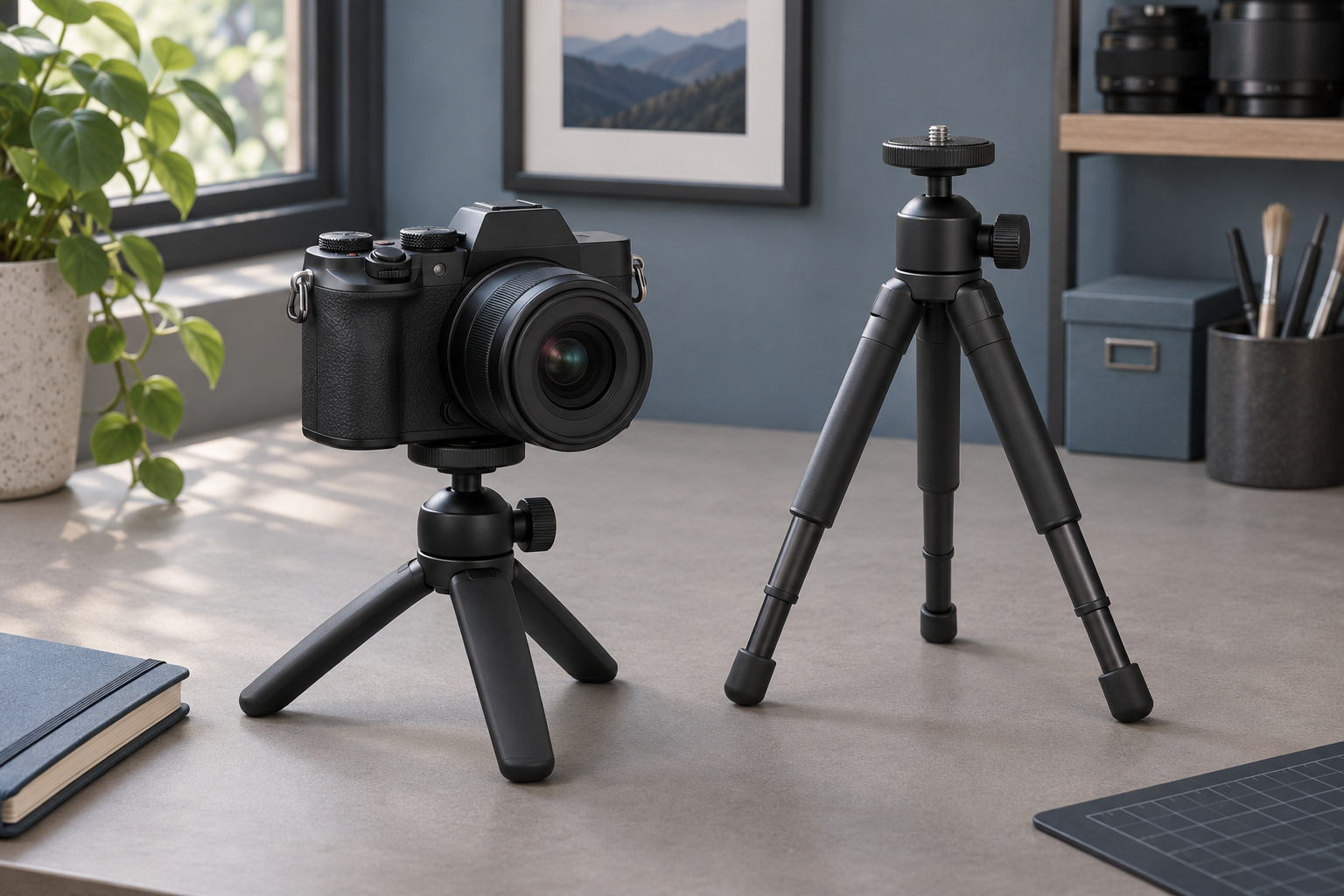
The Manfrotto PIXI is the simpler choice for a small camera that mostly stays level on a desk. The PIXI EVO earns its place when portrait framing, adjustable legs or a heavier setup matter. Decide which problem you need to solve before buying: a support that fits your bag is useful only if it can frame the picture you actually want.
These are tabletop tripods for an existing surface, not substitutes for a standing-height tripod. This comparison uses Manfrotto’s published specifications rather than hands-on testing. It focuses on the black MTPIXI-B and MTPIXIEVO-BK models; similar names and accessory bundles can describe different purchases.
The choice in two practical setups
Manfrotto PIXI Mini Tripod MTPIXI-B — for a light, level setup
Choose the original PIXI for a compact camera and short lens when you want minimal adjustment between taking it out and framing a horizontal shot. Its push-button head and single-section legs suit a straightforward tabletop routine. Skip it if you regularly turn the camera sideways or need more height adjustment.
This Amazon search targets the black MTPIXI-B mini tripod. Check the selected result’s model number and included accessories; a phone clamp or bundled mount changes what you are ordering.
Check this model on Amazon: Manfrotto PIXI Mini Tripod MTPIXI-B (paid link)
Manfrotto PIXI EVO Mini Tripod MTPIXIEVO-BK — for more framing options
Choose the EVO when its portrait tilt, two-section legs and two leg-angle settings address a real limitation in your setup. It offers more adjustment but takes more care to position consistently. Skip it if you need standing height, overhead reach or support for a camera that exceeds its stated limits.
This Amazon search targets the black MTPIXIEVO-BK. Match that identifier before choosing a result, and distinguish the tripod itself from kits with extra holders.
Check this model on Amazon: Manfrotto PIXI EVO Mini Tripod MTPIXIEVO-BK (paid link)
What the size difference buys you
Manfrotto lists the PIXI at 190g, with a 13.5cm maximum height and 18.5cm closed length. The EVO is 260g, reaches 20cm and closes to 20.5cm. The extra 70g is a modest bag penalty, but neither gives you the freedom to choose any camera height independently of the furniture beneath it.
Picture your usual desk before choosing. A support beside a laptop may need only enough elevation to clear the keyboard. A camera looking across a tall monitor needs a different solution. Measure from the tabletop to the desired lens position, allowing for the camera body and mounting point, rather than treating tripod height as lens height.
The EVO’s adjustable legs are useful when a fixed stance leaves your composition awkward. They also introduce settings you must repeat when photographing a sequence. For a permanent desk position, mark the camera location and subject position so that moving the tripod does not become a fresh framing exercise every time.
Portrait framing is the decisive difference
The original PIXI’s published tilt range is 35 degrees in either direction. The EVO permits a full 90-degree camera tilt for portrait orientation. That difference matters if vertical photos are a routine deliverable: rotating the camera on the support can preserve more of the original frame than planning every image around a later crop.
Portrait capability does not remove the need to check balance. Turning a camera sideways moves its weight relative to the legs. Set up over a stable surface, keep a hand ready while adjusting, and inspect whether the lens or camera could strike the tabletop. Avoid positioning valuable equipment at the edge simply to gain room for a tilted body.
If you only occasionally need a vertical image, consider whether repositioning your subject and cropping is acceptable. If you repeatedly shoot vertical product photographs or portraits from a tabletop, buying the model with the required movement is easier than working around a limited head each session.
Payload: weigh the whole working camera
The published safety payload is 1kg for the PIXI and 2.5kg for the EVO. Count the attached lens, battery, microphone, receiver and any mounting accessories, not just the camera body. Leave room in your decision for the equipment you actually use together; a bare-body specification can understate the working load.
Those limits do not promise that every combination below them will balance equally well. A long lens shifts weight forward, while a cable can tug sideways. Start with a compact lens, keep the load centered, and check the stance before releasing your hold. A higher payload figure alone is not a reason to put a large telephoto setup on a small tabletop footprint.
For a camera with a substantial lens or frequent accessory changes, a larger support may be a better purchase. Our camera tripod guide can help you consider the broader support category before committing to a mini model.
Desk video and small-product photography
For a seated video call or a fixed talking-head shot, begin with the framing and eye line. A very low camera can make a tidy desk setup look awkward on screen. Raise the supporting surface only with a secure, suitable platform; a precarious stack of books defeats the purpose of buying a stable support.
Neither model should be bought as a replacement for a fluid video head. A static camera position is a different job from a controlled moving pan. If your videos require repeated smooth movements, choose equipment designed for that movement rather than expecting a small ball head to provide it.
For small products, the EVO’s extra positioning choices may help you work around the subject. Lighting, background distance and the camera’s own close-focus ability still determine what you can photograph. See our product photography tips for planning the scene around the camera instead of asking the tripod to solve every problem.
Check the mount and your daily routine
Both models use a fixed platform with a standard quarter-inch camera screw. Check your device’s mounting provision before buying. A phone generally needs a suitable holder; an action camera may require its own adapter. Do not assume that an accessory shown in a search-result image is included with the exact result you select.
Think about how often you remove the camera. A fixed screw mount means attaching and detaching it is part of the routine. If you swap supports repeatedly, decide whether that workflow is acceptable before adding adapters that bring extra weight, height and another connection to check.
Which one belongs in your bag?
Choose the PIXI when simplicity, smaller packed size and a light horizontal setup describe your actual use. Choose the PIXI EVO when you can name the shot its portrait movement or adjustable stance will enable. Skip both when the missing feature is standing height or a substantially larger support footprint. Buying for a specific framing need gives either tripod a clearer purpose than choosing on payload alone.