
Film Schools in Virginia: Current Programs to Compare (2026)
Virginia students can choose among a public interdisciplinary film BA, arts-focused programs, a Christian production program, and a liberal-arts film path. The right choice depends heavily on whether the student wants intensive production, critical study, a particular campus culture, or access to the Washington, Richmond, or Hampton Roads media markets.
Current film programs in Virginia
Use these profiles to build a starting list, then confirm every requirement, deadline, degree name, application step, and campus location with the program itself before making a final decision.
George Mason University
Film and Video Studies BA
Mason’s collaborative BA combines production, business, ethics, and film analysis. Current pathways include areas such as directing, producing, cinematography, post-production, and screenwriting, and the major has its own portfolio review.
Virginia Commonwealth University
Cinema BA
VCU’s arts environment in Richmond makes it worth considering for students interested in narrative filmmaking and a city-based creative community. Verify the current Cinema curriculum, portfolio milestones, and how production crews and thesis work are assigned.
Regent University
Film & Television BFA
Regent’s BFA provides production training in areas such as producing, directing, editing, camera, sound, and scriptwriting from a Christian worldview. Students should decide whether that mission and campus culture fit their goals as carefully as they compare facilities.
Hollins University
Film BA, minor, and certificate
Hollins offers film and video production in a liberal-arts setting and identifies its undergraduate program as designed for women. It may appeal to students who want close faculty interaction and space to connect film with writing or other arts.
How to compare film programs
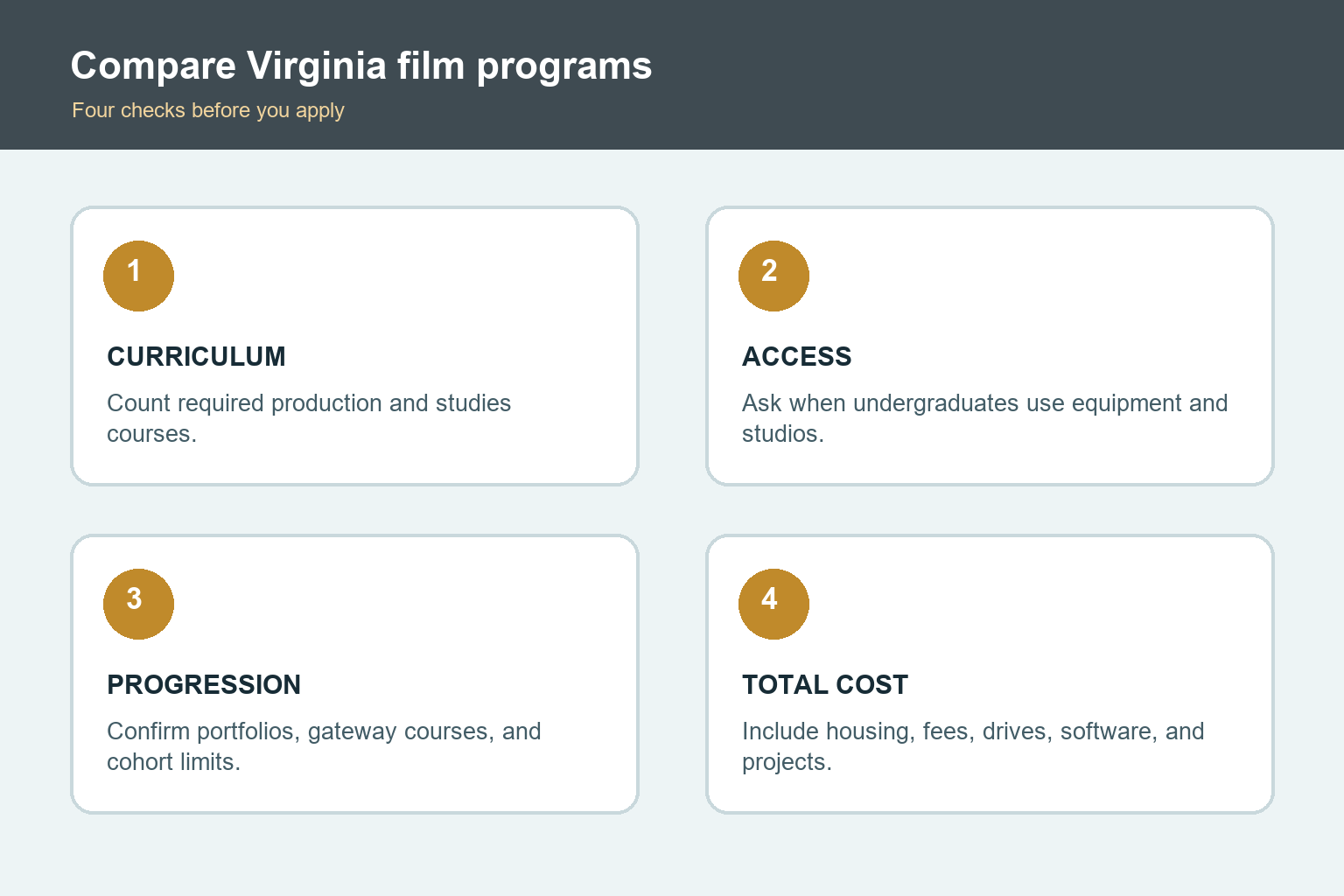
Start with the degree itself. A BA usually leaves more room for liberal-arts study or a second subject, while a BFA often devotes more credits to studio work. Neither label guarantees stronger production training. Read the required course sequence and count the advanced classes in directing, cinematography, sound, editing, producing, screenwriting, animation, documentary, and film history. Then check which electives ran during the last several terms. A long catalog list is less useful when the courses a student wants are offered rarely or reserved for a small cohort.
Look past cameras and soundstages
Facilities matter only when undergraduates can use them. During a visit, ask when students may check out cameras, whether insurance or lab fees apply, how editing suites are scheduled, and who receives priority for soundstages. Request links to recent student films from ordinary classes as well as polished senior projects. Strong work should show storytelling, sound, editing, and collaboration rather than only expensive equipment. Also ask how the school teaches safe sets, releases, music rights, accessibility, archival storage, and responsible use of new production technology.
Understand admission and progression
Some universities admit students directly to the film major. Others admit them to the university first and require a later portfolio, gateway course, minimum grade, or competitive review. That difference can change the risk and time needed to graduate. Transfer students should get a written evaluation of production credits because a course with a similar title may not replace a sequenced studio class. Ask what happens if a student is not admitted to the upper division and whether a related major can use completed credits without adding extra semesters.
Build a realistic cost comparison
Use each school’s official net-price calculator and financial-aid offer, then add expenses that may sit outside tuition: camera insurance, media drives, software, lab fees, transportation, housing, festival submissions, and contributions to student productions. Compare the full cost through graduation rather than one advertised annual figure. A lower-cost program can leave room to make independent work, accept a useful internship, or avoid heavy debt. A higher-cost program should provide clear curricular access and support that the student will actually use, not just impressive facilities on a tour.
Consider the surrounding production community
A nearby film industry can create internships, crew calls, guest speakers, and rental access, but location is not a substitute for teaching. Ask how many students receive structured internships, whether opportunities carry academic credit, and how transportation works. Smaller cities can offer easier locations and closer crews, while large markets may offer more professional exposure with more competition and higher living costs. The best setting is one where the student can make several complete projects, build dependable relationships, and graduate with both a portfolio and a sound financial plan.
Plan for work after graduation
A film degree does not guarantee a directing job, and employment data for broad media categories cannot predict one graduate’s outcome. Look for a curriculum that develops transferable skills in writing, project planning, collaboration, camera, sound, editing, and client communication. Ask the department for recent graduate examples and the methods used to collect them. A useful career plan includes several possible roles, a portfolio that can be shown legally, dependable professional references, and enough financial flexibility to take entry-level or freelance work while building experience.
Questions to ask before applying
Ask who owns student work, whether the school can use it for promotion, and what happens to footage after graduation. Confirm average crew size, how directing roles are assigned, whether students can work across departments, and what career services do specifically for film graduates. Ask for current retention and graduation information from the institution, not anecdotes. Finally, speak with at least two current students without an admissions representative directing the conversation. Their answers about scheduling, equipment, faculty feedback, and project costs often reveal how the program operates day to day.
Final perspective
The strongest film program in Virginia is the one whose required work, teaching style, cost, and campus setting match the student’s goals. Build a short list from official degree pages, then verify access and progression directly with each department. Programs change, and no article can replace the current catalog or a written answer from an adviser. Save copies of the degree map, financial offer, transfer evaluation, and important department answers so the comparison rests on the same enrollment year. A careful comparison should leave the student knowing what they will make, what they will study, what it will cost, and what happens if their interests change.
Editorial note: This independent educational guide contains no affiliate product links. Schools do not pay for placement, and the list is not a formal ranking.