
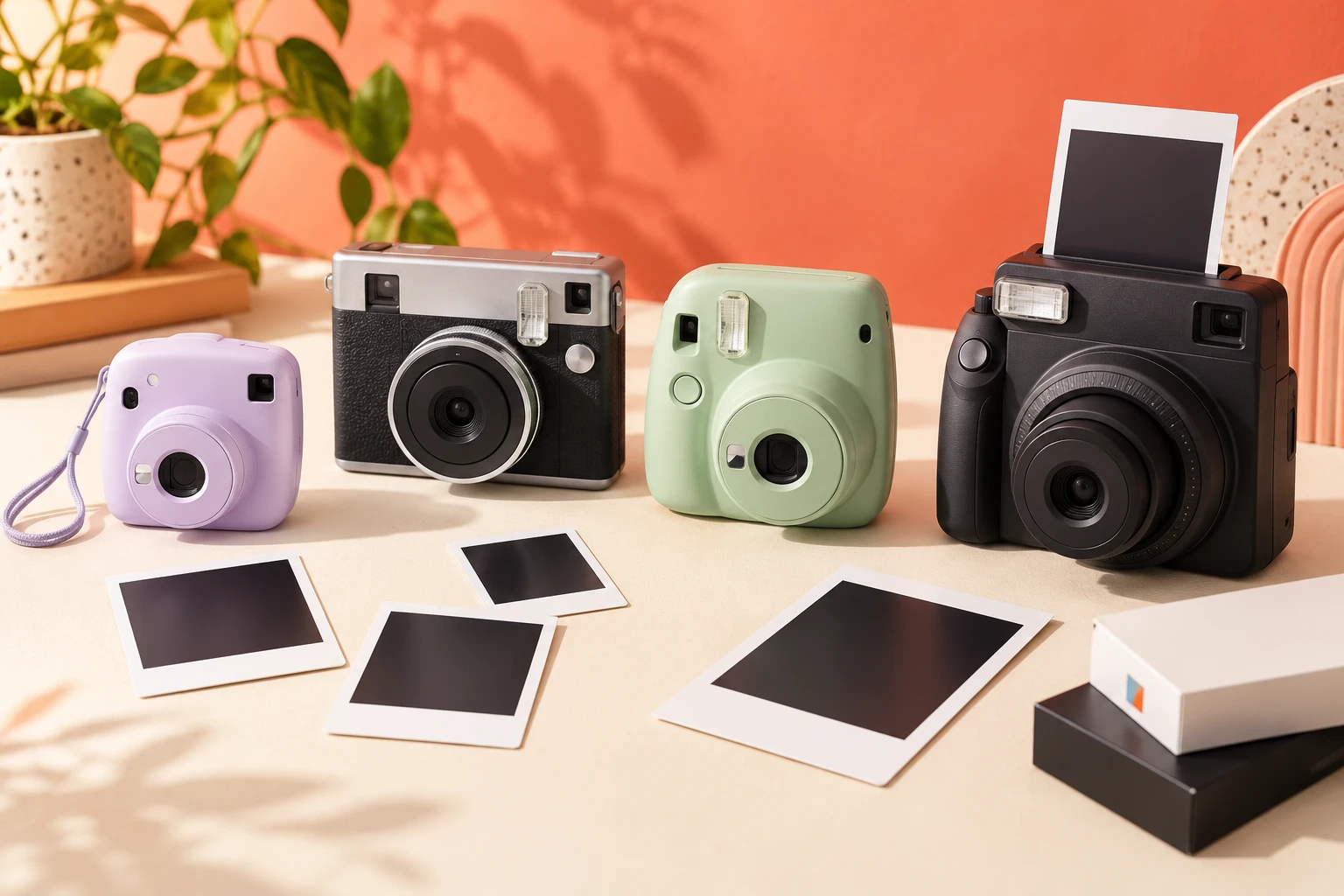
Best Polaroid Cameras in 2026: Six Current Choices
Polaroid’s current instant cameras differ in size, controls, focusing, connectivity, and film. The smallest Go uses its own smaller film. The Now, Now+, Flip, Mod, and premium I-2 use full-size i-Type or 600 film. Film cost and carrying size should be part of the decision from the start, while newer does not automatically mean better for every photographer.
Our recommended shortlist
The pocket-size choice for casual outings. It uses Polaroid Go film, not i-Type or 600 film.
A small instant-film option when you want miniature Polaroid Go keepsakes rather than full-size prints.
Find in Amazon (paid link)
A straightforward full-size point-and-shoot model for people who want the classic experience with minimal setup.
A full-size Polaroid option when a straightforward instant-photo experience is what you want.
Find in Amazon (paid link)
A connected full-size model for photographers who want app-assisted creative controls while keeping a simple physical camera.
A full-size Polaroid option when a straightforward instant-photo experience is what you want.
Find in Amazon (paid link)
A current easy-to-use model with sonar autofocus, a four-lens hyperfocal system, scene analysis, and a powerful flash.
A Polaroid direction when you want a camera you can pass around for everyday instant photographs.
Find in Amazon (paid link)
The newest creative model, built around four physical creative modes and a direct control dial without requiring a phone.
A creative Polaroid option when you prefer exploring modes on the camera rather than through a phone.
Find in Amazon (paid link)
The enthusiast model with more exposure control and a premium lens system for photographers willing to learn and pay more.
An instant-film option when you want more exposure control and are happy to spend time learning it.
Find in Amazon (paid link)
Choose the film format first
Go film produces smaller prints and fits only Go cameras. Full-size i-Type film works in rechargeable modern i-Type cameras but lacks the battery built into 600 packs. Many current full-size cameras can also use 600 film. Always follow the exact model’s film compatibility list; a box that looks similar may not fit or power the camera correctly.
Budget by cost per finished picture
Divide the delivered film price by the number of exposures. Leave room for test frames, missed focus, and learning the flash. Instant photography is most enjoyable when the photographer can make deliberate pictures without feeling that every press is financially risky. Buying more film does not help if heat, age, or poor storage has damaged it.
Now versus Now+
The Now is the simpler option for direct point-and-shoot use. The Now+ adds Bluetooth app features and greater creative control for light painting, aperture choices, or tripod work. Those extras are worthwhile only if the owner will connect a phone and practice. For a gift, simplicity may be the stronger feature.
When the I-2 makes sense
The I-2 is for an enthusiast who wants to meter, focus, and control exposure more deliberately while staying within the limits of instant film. It cannot make film inexpensive or perfectly predictable. Buyers should compare its total cost with a simpler camera plus a substantial film budget, especially if spontaneous social pictures are the main goal.
Flip and Mod fill newer roles
The Flip is the stronger point-and-shoot choice when dependable focusing, flash, and exposure warnings matter. The Mod is the newer creative option for photographers who want hands-on modes controlled from the camera rather than an app. These models do not make the Now or Now+ obsolete; they serve different priorities and budgets.
Improve results with light and distance
Instant film needs generous light. Keep subjects within the camera’s useful focus and flash range, avoid backlighting unless intentionally compensating for it, and hold the camera steady until the exposure is complete. Protect the emerging print from harsh light and heat while it develops. Do not shake, bend, peel, or squeeze it.

How we evaluated the options
Our selection process starts with the photographer’s actual use: subject, lighting, carrying tolerance, existing lenses, and willingness to learn controls. We then compare the features that change the result in that use case, rather than counting every menu item. Image quality matters, but autofocus behavior, viewfinder comfort, control layout, battery planning, and lens availability often decide whether a camera remains enjoyable after the first week.
Verify the exact listing
Prices, bundles, firmware, and availability change. Treat the links in this guide as a way to compare current listings, then verify the manufacturer specification page, included accessories, warranty source, seller, and return policy. Marketplace titles can mix generations or mounts. The product box, model number, and mount marking should agree before the return window closes.
Write down the intended use before comparing listings. Include the subject, typical light, longest comfortable carrying time, and the feature that would solve the largest current frustration. This short note makes it easier to ignore attractive specifications that do not improve the photographs you actually want to make.
Plan a first-week test while the return period is open. Photograph a familiar indoor subject, an outdoor scene, a moving person or pet, and the closest subject the equipment is meant to handle. Review the files on a larger screen, repeat any weak result, and separate technique problems from equipment limits.
Keep the setup understandable. Add one accessory or control change at a time, label batteries and chargers, format cards only after files are backed up, and store the manual where it can be found. A dependable routine protects equipment and makes it much easier to notice when a new setting causes an unexpected result.
Write down the intended use before comparing listings. Include the subject, typical light, longest comfortable carrying time, and the feature that would solve the largest current frustration. This short note makes it easier to ignore attractive specifications that do not improve the photographs you actually want to make.
Final recommendation
Choose the Go for true portability, the Now for a direct classic experience, the Now+ for app-assisted experiments, the Flip for dependable point-and-shoot use, the Mod for camera-controlled creative modes, and the I-2 for advanced manual involvement. Whichever model wins, buy the correct fresh film from a reliable seller and plan how finished prints will be stored or displayed.
Affiliate disclosure: As an Amazon Associate, Digital Camera HQ may earn from qualifying purchases. Prices and availability change. Product links use the site tracking tag digitalcamera-hd-20.