
Best 35mm Lenses for Canon: Current RF and Legacy EF Options (2026)
The 35mm choice depends on the mount
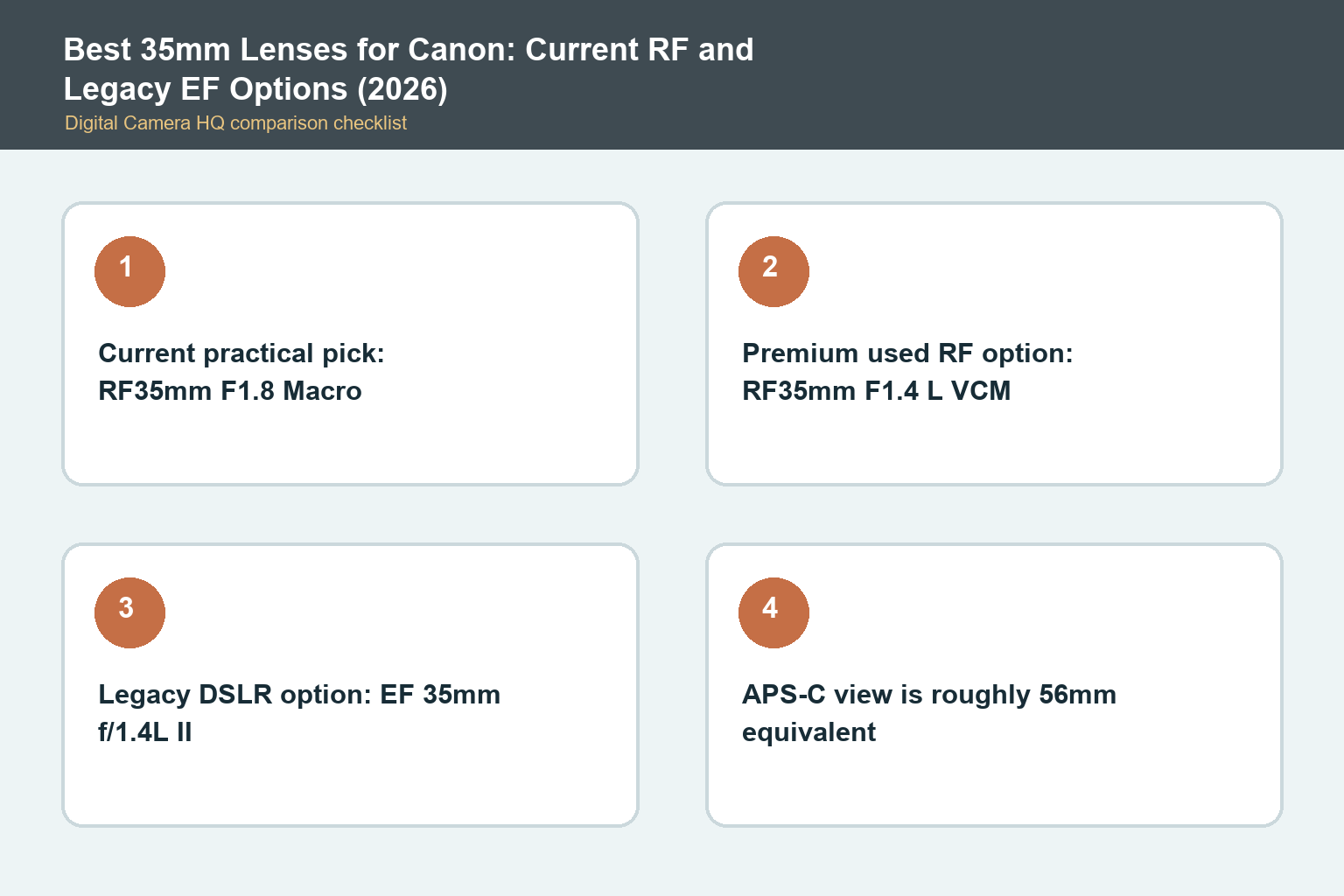
A 35mm lens gives a moderately wide view on a full-frame Canon body and a normal-looking view, roughly equivalent to 56mm, on Canon APS-C cameras. The first buying question is therefore not maximum aperture. It is whether the camera uses the RF, EF, or EF-S mount. RF lenses fit EOS R bodies directly. EF lenses can work on EOS R bodies with a compatible Canon EF-EOS R adapter and continue to fit Canon DSLRs. EF-M lenses do not adapt to RF cameras. Confirm the exact body before comparing price or sharpness.
Best current native value: RF35mm F1.8 Macro IS STM
The RF35mm F1.8 Macro IS STM is the easiest recommendation for most EOS R owners. It combines a bright f/1.8 aperture, optical image stabilization, compact dimensions, and close focusing to 0.5x magnification. That makes it useful for travel, environmental portraits, food, details, and handheld video. Autofocus is smooth rather than sports-lens fast, and the extending focus design and focus-by-wire feel may not suit every professional workflow. Its balance of size, price, and versatility is stronger than buying a large premium lens simply for occasional shallow depth of field.
Premium RF option: RF35mm F1.4 L VCM
Canon introduced the RF35mm F1.4 L VCM as a professional hybrid stills-and-video lens with an f/1.4 aperture, weather-resistant construction, reduced focus breathing, an iris ring, and a dual-motor focusing design. Canon's current store marks it discontinued, so it should be treated as a used or remaining-stock purchase rather than an ordinary current recommendation. It can be compelling for paid low-light work and controlled video, but inspect price and warranty carefully. A discontinued premium lens is not automatically a bargain when repair support, seller terms, or replacement cost are uncertain.
Legacy EF option: EF 35mm f/1.4L II USM
The EF 35mm f/1.4L II USM remains a strong optical tool for Canon DSLR owners and EOS R users comfortable with an adapter. Canon also marks this model discontinued. It is large and heavy beside the RF35mm F1.8, but offers a bright aperture, durable L-series build, fast ring-type USM autofocus, and well-controlled color fringing. On an APS-C DSLR it behaves as a normal lens rather than a wide lens. Check focus accuracy on the actual DSLR body, look for impact or moisture damage, and include the size and cost of an adapter when comparing it with an RF lens.
What 35mm is good for
On full frame, 35mm is useful for documentary work, travel, street scenes, groups, environmental portraits, and interiors where a 50mm lens feels tight. It shows more context than a short telephoto without the dramatic edge stretching of an ultra-wide lens. Close subjects near the edge can still look distorted, so keep faces away from corners and step back for groups. On APS-C, the narrower view suits everyday details, portraits with context, and low-light general photography, but it may be too tight for small rooms.
Aperture, stabilization, and motion
An f/1.4 lens admits about two-thirds of a stop more light than f/1.8 and can produce slightly shallower depth of field at the same distance. That difference matters in some professional low-light situations, but it does not freeze motion by itself or guarantee a sharper photograph. Optical or in-body stabilization helps reduce camera movement on static subjects; it cannot stop a walking person. Select shutter speed for subject movement, then use aperture and ISO to support it. Wide-open focusing tolerance can be narrow, so verify the intended eye or detail.
Video and focus behavior
Video shooters should consider focus breathing, motor noise, manual-focus response, stabilization, and whether the aperture controls work as expected on the selected body. The RF35mm F1.4 L VCM was designed as part of Canon's hybrid lens family, while the smaller RF35mm F1.8 provides stabilization and close focusing at lower cost. Neither choice removes the need for microphones, support, lighting, or practice. Test focus transitions and handheld movement before a paid shoot, and update lens and camera firmware only through official Canon instructions.
How to inspect a used 35mm lens
Check front and rear glass under angled light for haze, fungus, deep scratches, separation, or cleaning damage. Inspect the mount, filter threads, switches, control ring, hood, and barrel for impact. Test autofocus at near, middle, and distant subjects, then compare left and right sides of a flat detailed scene at several apertures. A small amount of internal dust is common and usually harmless; haze, decentering, intermittent focus, or moisture damage is more serious. Confirm the serial number, seller return period, and compatibility before the return window closes.
Buying links and current availability
The links below are tagged Amazon searches rather than promises that one seller or configuration will remain available. Verify whether a listing is new, used, renewed, imported, or bundled with third-party accessories. For discontinued lenses, compare the complete delivered cost with the current RF35mm F1.8 and with rental rates for occasional jobs. A lens should solve repeated photographic needs and fit the camera you actually own. Do not pay a premium solely because an older model once held flagship status.
Product searches
Check current Amazon listings (paid link)
Check current Amazon listings (paid link)
Check current Amazon listings (paid link)
Sources and review notes
Affiliate disclosure: Digital Camera HQ may earn from qualifying purchases through eligible links. Product selection and editorial conclusions are independent.
Final buying check
Before ordering, confirm the exact model name, mount, seller, warranty region, included accessories, return period, and firmware support. Test the complete camera-and-lens combination during the return window. Photograph the subjects that motivated the purchase, review files at the intended output size, and check handling with the bag and accessories you will actually carry. A current model is useful only when it fits the work, budget, and support path better than a carefully inspected used alternative.