
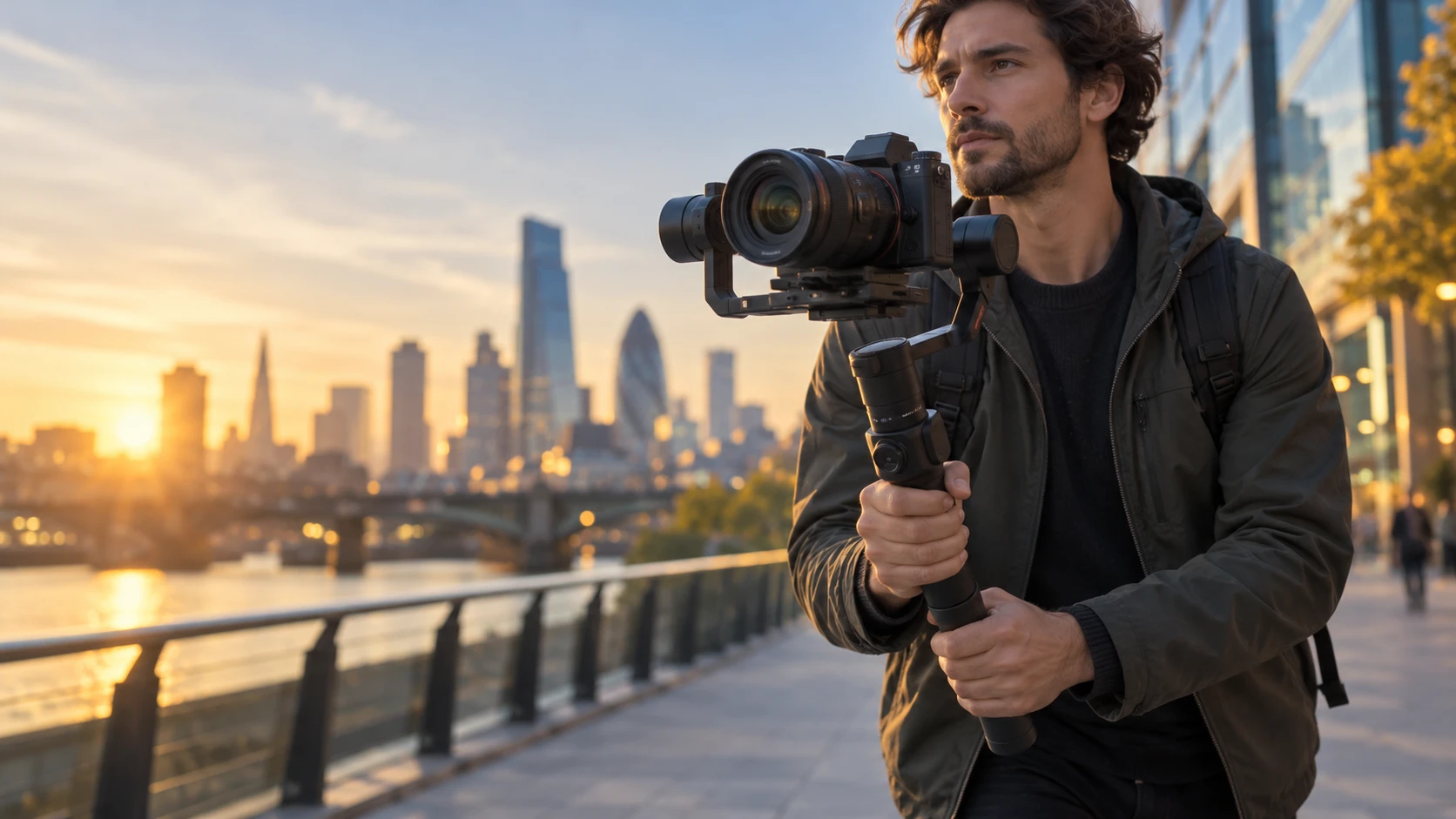
Best Camera Stabilizers in 2026
best compact all-around choice
best for heavier hybrid-camera rigs
best sling-style alternative
best value-focused current option
What a camera stabilizer can and cannot fix
A powered three-axis gimbal counters pitch, roll, and yaw while you move. It can make walking shots, reveals, orbits, and low-angle moves look more controlled, but it does not replace composition, careful footsteps, focus planning, or a safe grip. It also cannot fix a camera that is too heavy, physically blocked, or badly balanced. Tripods remain better for locked shots, and monopods can be faster for long events. A gimbal earns its place when moving-camera shots are a repeated part of the work.
Choose by the complete payload
Add the camera, lens, filter, plate, cage, microphone, receiver, cable, focus motor, and any counterweight before comparing capacity. Total weight is only the first check. A long front-heavy lens may exceed the available slide adjustment, a wide body can hit the roll arm, and a cable can snag as the axes move. Manufacturer compatibility lists are the best starting point, but they cannot cover every third-party cage and accessory. Build the intended rig, measure it, and leave motor and physical-clearance margin instead of selecting a gimbal at its stated limit.
DJI RS 4 Mini: Best Compact All-Around Choice
A compact mirrorless kit is where the RS 4 Mini makes the most sense. DJI rates it for a tested payload up to 2 kg, and the current model adds automated axis locks, a fine-tuning knob, native vertical shooting, and optional intelligent tracking. The important limitation is physical fit: a combination can fall below the weight limit and still strike an arm or become awkward to balance. Check DJI’s exact camera-and-lens compatibility list, include the plate and every accessory in the real setup, and choose the larger RS 4 when the working rig needs more clearance or expansion.
DJI RS 4: Best For Heavier Hybrid-Camera Rigs
The RS 4 is the stronger fit for full-frame zooms, cages, follow-focus accessories, and working rigs that outgrow a compact gimbal. DJI lists a tested payload of 3 kg and supplies second-generation native vertical shooting, automated locks, and smoother balancing surfaces. Extra capacity does not remove the need to balance each axis before power-on. It also brings more carried weight. Choose it when the complete rig repeatedly needs its clearance, motor margin, control ports, or accessory ecosystem; a smaller camera and prime lens may remain easier to operate on the RS 4 Mini.
ZHIYUN WEEBILL 3S: Best Sling-Style Alternative
The WEEBILL 3S remains a useful alternative for operators who prefer an adjustable sling grip and frequent low-angle work. ZHIYUN specifies native portrait and landscape switching, Bluetooth shutter control, a built-in fill light, and an 11.5-hour stated runtime. Its current compatibility pages cover a broad range of Canon, Sony, Nikon, Panasonic, and Fujifilm bodies, but support varies by camera function and connection method. Confirm the exact body, lens, cable, firmware, and desired control feature. Handle the complete kit if possible because grip position and forearm fatigue matter more than a feature list during a long shoot.
FeiyuTech SCORP-C 2: Best Value-Focused Current Option
The SCORP-C 2 is a current value-oriented choice with a T-shaped integrated handle, native vertical mounting, programmable A/B movement, and a stated 14-hour battery life. Those features suit low-angle moves, repeatable product shots, and creators who want a second grip without building a larger rig. Compatibility remains the deciding factor. Check FeiyuTech’s current camera-control list for the exact model and connection, verify lens clearance, and balance the real payload before running motor tuning. A lower purchase price is only useful when recording control, fit, service, and return terms match the assignment.
Balance mechanically before using motor power
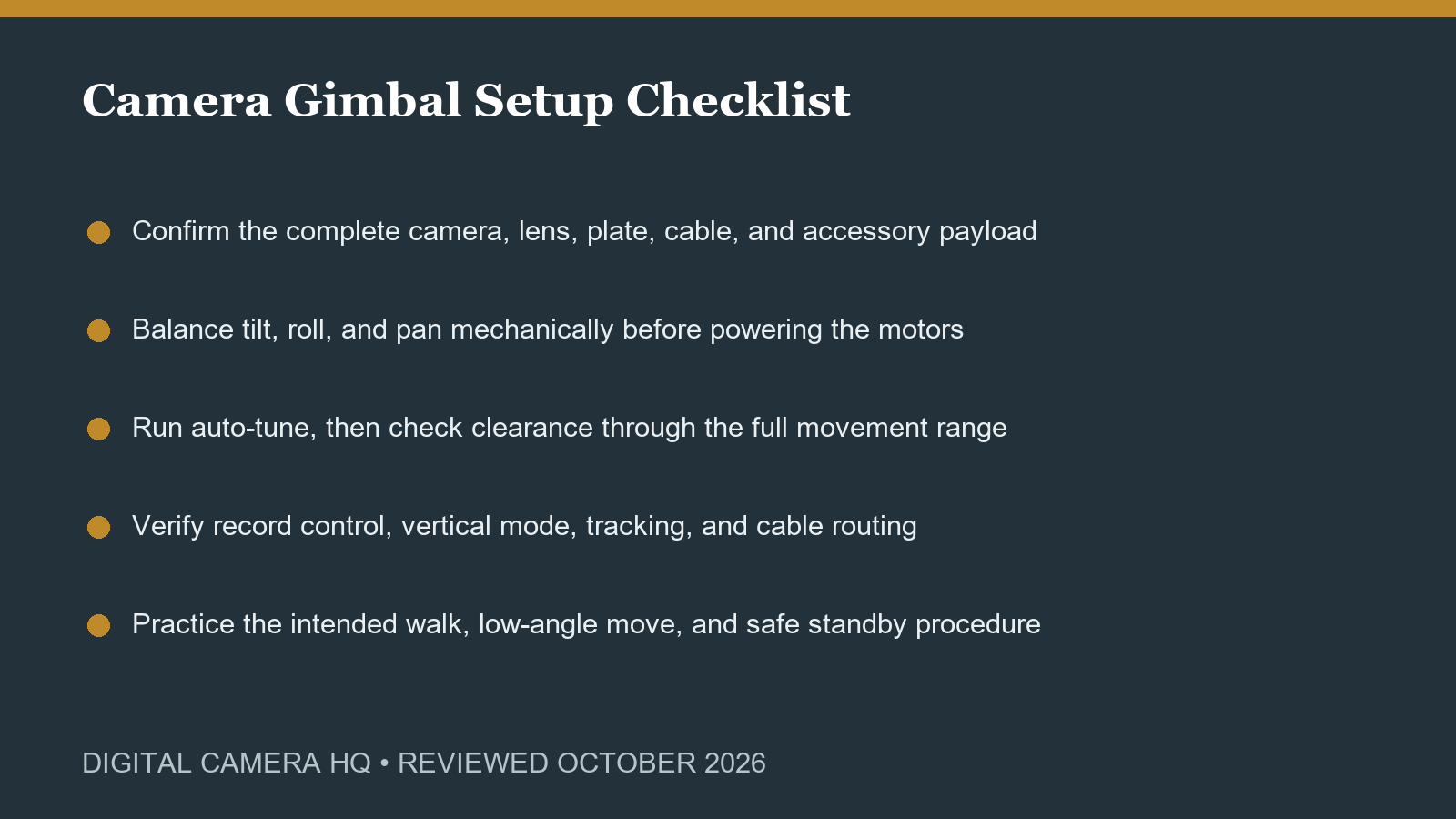
Mount the camera exactly as it will be used, then balance tilt, roll, and pan with the gimbal off. Each axis should remain near the position where it is released rather than falling quickly to one side. Only after that should you unlock every required axis, power on, and run auto-tune or motor calibration. Excess motor strength can create vibration and waste battery; insufficient strength can cause droop or overload warnings. Rebalance after changing lenses, zoom position, filters, plates, or accessories. Save repeatable plate marks for a rig that is assembled often.
Match the controls to the shots you make
Pan-follow is a dependable default for walking and event work. Pan-and-tilt follow is useful for reveals and changes in subject height, while FPV-style modes suit intentional roll and faster movement. Native vertical mounting matters when vertical video is a regular deliverable. Subject-tracking modules can help a solo operator, but check whether they require a separate accessory and which follow modes they support. Test record start, focus or zoom control, joystick direction, follow speed, deadband, and cable routing before a paid shoot. A simple setup you know well is safer than an elaborate one configured at the location.
Plan for battery, fatigue, and safe operation
Published battery runtimes are reference figures, not guaranteed shooting times. High motor load, cold weather, accessories, repeated standby cycles, and phone connections can reduce endurance. Charge the gimbal and camera separately, carry the correct cables, and practice putting the system into standby before setting it down. Use the supplied mini tripod only on a stable surface and never leave a top-heavy rig unattended. For long sessions, compare total weight, grip positions, sling support, and setup time. Resting between takes and alternating hand positions can improve footage more than choosing the model with the largest payload number.
How to test a new gimbal during the return period
Record the same short sequence with each intended camera and lens: a slow walk, stop and start, pan, tilt, low-mode move, orbit, vertical clip, and locked-off frame. Look for horizon drift, micro-jitters, motor noise, arm collisions, cable pulls, and focus problems at full size. Check Bluetooth and wired controls, app requirements, firmware, plate repeatability, charging, and how the unit fits its case. Repeat the test after ten minutes of use, when fatigue exposes handling problems. Keep packaging until the complete system has passed the real workflow.
Amazon links and availability
These tagged searches help locate the exact model while allowing for changing stock. Search results may mix generations, bundles, used items, imports, phone gimbals, and similarly named accessories. Match the complete model name to the official compatibility page, confirm the seller and warranty region, and review included plates, grips, tracking modules, cables, and return terms before ordering. Prices are omitted because they change frequently.
Check current Amazon listings (paid link)
Check current Amazon listings (paid link)
Check current Amazon listings (paid link)
Check current Amazon listings (paid link)
Affiliate disclosure: Digital Camera HQ may earn from qualifying purchases through eligible links. Product selection and editorial conclusions remain independent.
Official sources and review notes
- DJI RS 4 Mini product and specifications
- DJI RS 4 product information
- ZHIYUN WEEBILL 3S product information
- ZHIYUN WEEBILL 3S camera compatibility
- FeiyuTech SCORP-C 2 product information
Official manufacturer product, support, and compatibility pages were reviewed during the October 2026 refresh. Features, bundles, camera control, and availability can change; confirm the exact model and current compatibility document before purchase or a critical assignment.
Final recommendation
Start with the lightest gimbal that safely fits the complete rig and the shots you repeat. For many compact mirrorless kits, that is the DJI RS 4 Mini. Move to the RS 4 when payload, clearance, and expansion justify the extra weight. Prefer the WEEBILL 3S when sling handling fits the way you work, and compare the SCORP-C 2 when value and integrated low-angle control matter. Whichever model you choose, careful mechanical balance, realistic practice, and a short compatibility test determine whether the stabilizer will improve the finished footage.