
Reviewed and updated: November 4, 2026
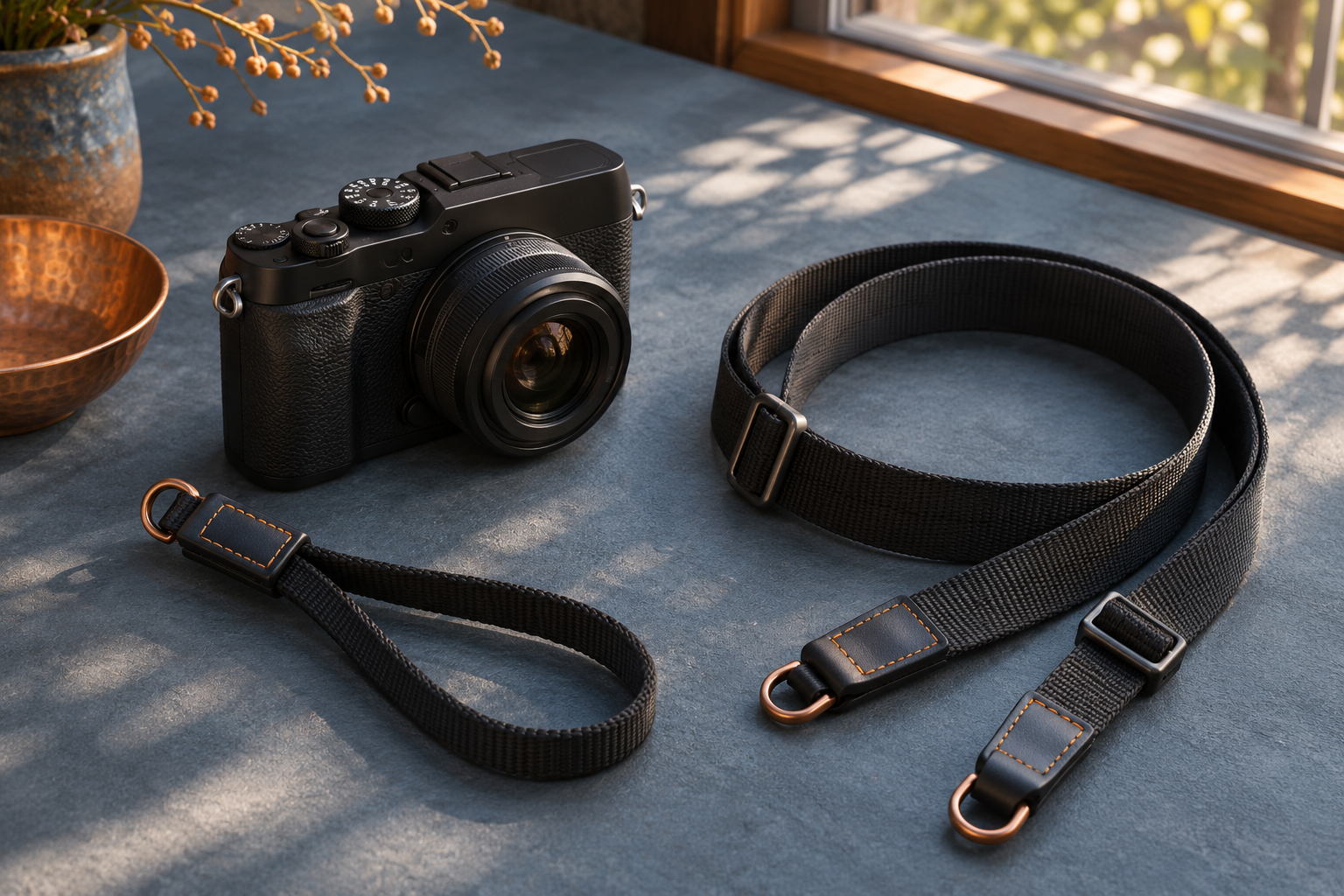
A wrist strap and a neck strap solve different problems, even when both use the same quick-release connectors. Peak Design Cuff keeps a handheld camera tethered to your wrist. Peak Design Leash lets a small camera hang from your body between photographs. Choose around what happens when you stop shooting: will you keep holding the camera, put it in a bag, or want both hands free?
For a compact camera used in short, concentrated shooting sessions, Cuff is the simpler choice. For travel walks with frequent pauses, Leash is the more useful starting point. This comparison covers the standard woven Cuff and Leash, based on current manufacturer information and practical use-case analysis. It does not report hands-on testing or compare the separate rope, leather, or mobile strap ranges.
Peak Design Cuff Camera Wrist Strap — for active handheld shooting
Cuff uses Peak Design’s Anchor Link connection and a wrist loop that can stay open or cinch down. An adjustable magnet holds the loose end when worn as a bracelet. Choose it when you want a compact tether while keeping the camera in your hand; skip it when your main need is carrying the camera with both hands free.
Use the Amazon search below to compare results for the standard black woven camera Cuff, checking the selected version before buying.
Check this model on Amazon: Peak Design Cuff Camera Wrist Strap (paid link)
Peak Design Leash Camera Strap — for carrying between shots
Leash is a minimalist camera strap with Anchor Link connectors and dual quick-adjusters. The manufacturer lists an adjustable length from 33 to 57 inches. Choose it for a small camera that you want to carry between shots; skip it if you need a broad padded strap for a heavy kit or only want a short wrist tether.
The Amazon search below targets the standard black camera Leash. Confirm the actual strap, color, included parts, and seller rather than assuming every result matches.
Check this model on Amazon: Peak Design Leash Camera Strap (paid link)
The deciding question: what do your hands need to do?
Picture an ordinary ten minutes with your camera. If you raise it, make several frames, and keep it ready in your hand, a wrist tether adds little material around your upper body. Cuff suits that pattern. You still support the camera with your hand; the tether is a backup against an accidental slip rather than a reason to deliberately drop it.
If those ten minutes include reading a map, adjusting a jacket, or helping someone else, a longer strap becomes more useful. Leash provides a place for the camera to rest against your body while your hands do something else. Keep a hand on it when moving through crowds or around obstacles: suspended equipment can still swing or strike something.
Cuff: a compact choice with a clear limitation
Cuff’s adjustable wrist loop and removable connection make sense for photographers who alternate between a bag and short handheld sessions. The magnetic storage arrangement also gives the detached strap somewhere to go. Those features are useful if loose strap ends tend to catch on a bag opening, though actual handling depends on your camera, clothing, and wrist fit.
The limitation is fatigue and hand availability. A small tether does not distribute the camera’s weight across your shoulder. If a long walk leaves your fingers tired, shortening the strap will not solve the underlying carrying problem. Choose Cuff for the time spent actively holding the camera, and plan to return the camera to a bag when that session ends.
Leash: better for pauses, with less cushioning
Leash’s adjustable length lets you change how closely the camera sits against you. That matters when switching between a light shirt and outerwear, or when you need more reach to frame a photograph. The dual adjusters and Anchor Link connections are manufacturer-described features; whether the adjustment is comfortable for you requires checking it with your own clothing and camera.
A minimalist strap also has a predictable compromise: less material to spread pressure. A compact body with a short prime is a more natural starting point than a large body and long telephoto. If your normal setup already feels heavy on a thin strap, consider a wider carrying solution. Do not buy Leash simply because it packs small while ignoring the load you will carry.
Check the connection before choosing a strap
Inspect the camera’s approved strap attachment points and read its manual. Do not assume that an accessory cage, small decorative loop, or unrelated mounting point is suitable for supporting the equipment. Check how the selected connectors route through the intended points, keeping cords away from sharp edges and controls. Never force a connector through a tight opening.
With any detachable system, verify that each connection is fully seated before lifting the camera. Support the equipment over a soft surface while learning the release. Inspect cords, webbing, and hardware routinely and follow the manufacturer’s replacement guidance. A connector strength claim is not a guarantee for every camera attachment, damaged cord, or sudden impact.
Try the camera movements you actually use
Before committing to either style, rehearse bringing the camera to your eye, using a rear screen at waist level, and turning it vertically. A strap that suits one position can pull across a dial in another. Include the lens you normally carry, because a heavier front end changes how the equipment hangs and how much effort your hand supplies.
Check battery-door access, screen articulation, and the way the strap enters your bag. If you use a tripod, verify that your chosen attachment arrangement leaves the plate secure and reachable. Our camera strap buying guide covers the wider choice of carrying styles if neither of these lightweight options suits your equipment.
Buy one first unless your routine needs both
Shared connectors can make two strap styles convenient, but compatibility alone is not a reason to buy both. Start with the problem that interrupts your photography most often. If it is accidental-slip anxiety while holding a compact camera, choose Cuff. If it is having nowhere convenient to put that camera during pauses, choose Leash.
Owning both becomes sensible when you regularly switch between a walking setup and a dedicated handheld session. Make every change with the camera supported, and keep the removed strap in a consistent pocket. Avoid swapping connectors while balancing equipment on a wall, leaning over water, or walking. A quick connection should still be a deliberate action.
Match the exact version before ordering
Search results can mix camera straps, mobile straps, alternative materials, colors, connector accessories, and bundles. Compare the complete product name and photographs with the version discussed here. Check package contents and the seller’s return terms. A bag of replacement connectors is not the complete strap, and a similarly named mobile accessory should not be assumed equivalent.
Choose Cuff for compact drop protection during active handheld use, and Leash for carrying a small camera between photographs. Skip both if a heavy setup needs a different support system. Keep the strap clean, inspect it before outings, and follow its care directions; our camera strap cleaning guide explains why preserving the attachment hardware matters alongside cleaning the fabric.